




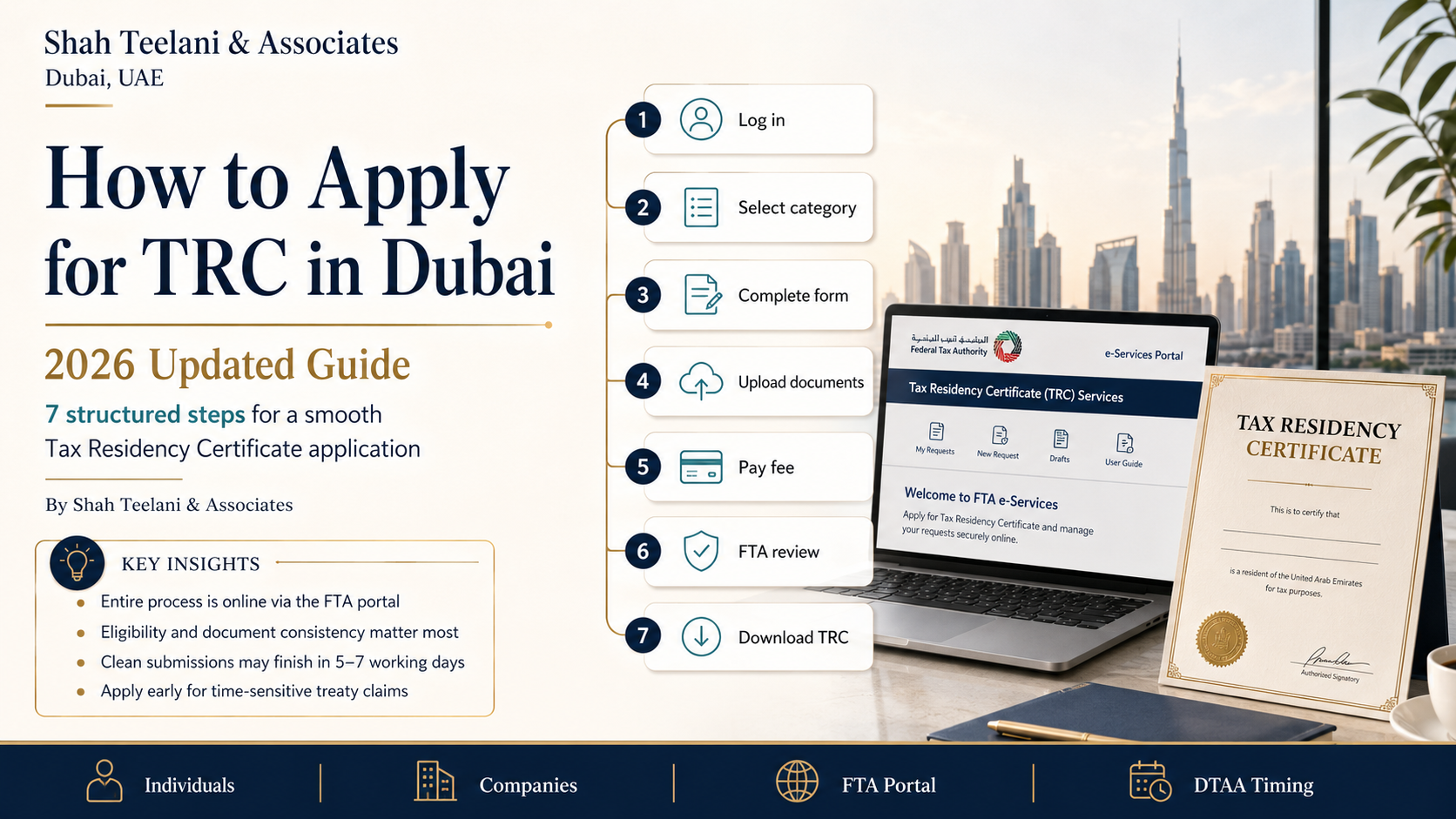
Dubai has become a top base for mobile professionals, entrepreneurs, investors, and family offices from the UK, USA, Europe, and GCC countries. Global income streams keep getting more complex. So one question comes up again and again: how does TRC in Dubai cross-border tax strategy help non-Indian nationals manage international tax exposure? This guide covers treaty positioning, global reporting alignment, multi-jurisdiction coordination, and planning considerations for each nationality group.
Why a TRC Matters for Non-Indian Nationals in Dubai
The UAE has grown into a globally recognised hub for wealth management and long-term residency. For nationals relocating from the UK, USA, EU, and GCC, a Tax Residency Certificate has become a key part of cross-border financial planning.
In practice, non-Indian nationals rarely deal with just one treaty. Most juggle investments, businesses, or pension interests at home while living in the UAE. A TRC issued by the Federal Tax Authority anchors UAE tax residency formally. It supports treaty applications worldwide. It also cuts down ambiguity in an era of tighter global tax transparency.
Several situations make a TRC relevant. Maybe you still hold investments, rental property, or a business back home. Perhaps you earn foreign dividends, interest, royalties, or consulting income from overseas. You might be planning an exit, equity sale, or major capital event. Or you could be restructuring your global tax residency for wealth or succession purposes. Banks may also request updated residency classification under global reporting rules.
TRC in Dubai for UK Nationals
British nationals relocating to Dubai need a TRC to support a clean, defensible change of tax residence. The UK applies a detailed Statutory Residence Test (SRT). Getting this wrong means continued exposure to UK income tax, capital gains tax, and inheritance tax.
Statutory Residence and Split-Year Treatment
Documentation consistency matters most when ceasing UK residency. The SRT remains the primary test. But a UAE TRC adds weight. It shows a recognised foreign authority has formally confirmed your UAE residence. This becomes especially useful when split-year rules apply and HMRC scrutinises your departure date.
Capital Gains, Exit Planning, and Compliance
UK-source capital gains and dividends can stay taxable in the UK, depending on asset type and how long you’ve been non-resident. A TRC supports treaty claims under the UK–UAE tax treaty. It also helps establish the UAE side if HMRC asserts dual residency.
Founders face a sharper version of this problem. Relocating before a company sale, buyback, or private equity deal requires careful timing. UAE residency needs to be established before the UK departure date, not after. A TRC issued before the transaction date documents non-UK residence at the time of the gain. That timing can materially affect UK capital gains tax exposure.
Banks, pension trustees, and investment platforms add another layer. They often request updated residency documentation for CRS and FATCA classification. A UAE TRC satisfies these requests cleanly and avoids back-and-forth.
A TRC does not override UK domestic law or the SRT. Still, it strengthens the evidentiary record substantially when claiming non-UK residence and accessing treaty relief.
TRC in Dubai for US Nationals
US citizens and green card holders face a different challenge entirely: citizenship-based taxation.
The Citizenship-Based Taxation Reality
The USA taxes citizens on worldwide income no matter where they live. Moving to Dubai changes nothing on this front. Filing obligations continue regardless of UAE residence. These include US federal income tax on global income, FBAR reporting on overseas accounts, FATCA reporting on specified foreign assets, and self-employment tax in many cases.
Where TRC Remains Strategically Relevant
A TRC won’t eliminate US filing duties. But it still matters in several scenarios:
- Corporate structuring through UAE entities — a TRC shows genuine local tax residence, relevant to both UAE Corporate Tax and US rules like Subpart F and GILTI
- Banking compliance — brokers and custodians often need a TRC for CRS/FATCA account classification
- Foreign Earned Income Exclusion (FEIE) support — combined with the bona fide residence or physical presence test, it adds supporting evidence
- Third-country treaty positioning — for example, European royalty income routed through a UAE entity
The IRS evaluates residency under its own framework. That framework differs sharply from the UAE’s approach. US nationals should get specialist cross-border advice before relying on a UAE TRC for planning purposes.
TRC in Dubai for European Nationals
Germans, French, Italians, Spaniards, and other EU nationals relocate to Dubai often, for business and lifestyle reasons alike. Each country runs its own residence test. But common themes still emerge.
Exit Tax Planning
Germany, France, the Netherlands, and Spain all impose exit taxes on unrealised gains when residency ends. For instance, these can hit shares in private companies, large listed shareholdings, or other appreciated assets. TRC timing matters here. It documents the residence transition formally and can interact with the relevant bilateral treaty.
Investment, Holding Structures, and Banking Compliance
Treaty residence status often determines dividend withholding and capital gains treatment on European income. Some EU states offer reduced withholding rates to UAE residents under their treaties. Access typically requires a valid TRC as proof.
Founders using UAE holding entities face a related issue. Consistent, well-documented residency supports the whole structure. A TRC combined with real substance — staff, office, board meetings — helps defend against controlled foreign company (CFC) challenges back home.
CRS adds another layer across the EU. Banks must classify account holders by tax residence. A UAE TRC gives them the government-issued proof they need, cutting the risk of erroneous dual reporting.
EU anti-avoidance rules — including ATAD I and II — make documentation precision especially important here. Genuine substance matters as much as the paperwork.
TRC in Dubai for GCC Nationals
Saudi, Kuwaiti, Qatari, Omani, and Bahraini nationals can also obtain UAE tax residency, subject to presence and eligibility rules. GCC tax systems differ sharply from European or UK ones, so the planning picture looks different too.
Most GCC countries don’t tax personal income at all. So a TRC’s real value for GCC nationals usually lies outside the Gulf, not within it.
A few scenarios stand out. Investing outside the GCC in places that withhold tax on dividends, interest, or royalties is one — a UAE TRC can support treaty-reduced rates there. Offshore banking often needs formal residency proof too. Corporate structuring through UAE entities for trading, investment, or IP holding is another common case. Real estate or equity investment abroad can also require documented non-resident status back home.
GCC economies keep diversifying, and nationals increasingly invest globally. The TRC is becoming a more useful tool for that wider context.
Multi-Jurisdiction Income Scenarios Where TRC Becomes Strategic
Several recurring income patterns show where TRC in Dubai cross-border tax strategy adds the most everyday value.
UK rental income kept after relocation is one case — treaty provisions can limit UK withholding. US equity dividends and security sales need accurate residency classification too. European startup equity exits often trigger exit tax or capital gains at home. Global consulting contracts billed through a UAE entity usually need treaty protection against source-country withholding. Royalty and IP income from multiple countries often routes through UAE holding structures. Offshore distributions can also require UAE residency proof from the paying jurisdiction.
A TRC helps across all of these. It clarifies primary residence and cuts ambiguity during audits. It strengthens treaty claims and reduces dual-residency disputes. And it supports accurate compliance filings overall.
Dual Residency Risk and Treaty Tie-Breaker Rules
Unintentional dual tax residency is one of the biggest risks for mobile individuals. Someone can be UK-resident under the SRT, German-resident under habitual abode rules, or US-taxable by citizenship — all while also holding UAE residency.
Treaties handle this through tie-breaker provisions. These look, in order, at where you have a permanent home, where your centre of vital interests sits, where you habitually reside, and finally your nationality.
Even so, a TRC supports the UAE side of this analysis. On its own, though, it rarely settles the question. Supporting evidence still matters: physical presence records, lease agreements, UAE business licences, family relocation proof, and a local banking footprint. The full factual picture carries as much weight as the certificate itself.
Corporate Structuring for Foreign Nationals Using UAE Entities
Entrepreneurs from the UK, USA, and Europe often set up UAE entities for consulting, trading, IP holding, or family office work. A TRC plays several roles here:
- Confirms UAE corporate tax residence under UAE Corporate Tax Law
- Supports treaty applications filed by the entity with third-country authorities
- Establishes commercial substance in Dubai
- Assists with compliance reviews and foreign information requests
UAE Corporate Tax sits at 9% above AED 375,000 of taxable income, with 0% below that threshold. This makes the link between real substance and TRC documentation more commercially important than ever. Entities chasing treaty benefits need to show genuine economic activity — not just a registered address.
Economic Substance and Global Transparency Requirements
Tax authorities worldwide now share data constantly. The Common Reporting Standard covers over 100 jurisdictions, including the UAE. FATCA covers US persons globally. Bilateral exchange agreements add further coverage. Country-by-Country Reporting handles multinational groups separately.
In this world, a TRC needs real backing. Genuine residence, physical presence, and actual business activity all matter. Relying on a TRC without real relocation creates serious audit exposure at home.
Key principle: a TRC documents what already exists. It works best paired with a genuine, well-evidenced relocation — not as a standalone tactic divorced from real substance.
Timing Considerations for Non-Indian Nationals
Timing shapes outcomes more than people expect. Several scenarios show why:
- A business exit in Europe or the UK needs the TRC in place before the deal closes, not after
- Stock option or RSU vesting depends on residency status at the vesting date
- US securities sales need careful treaty positioning, even though US tax never fully disappears
- Large dividend distributions depend on residency at the distribution date
- Holding company restructuring or IP migration needs coordinated documentation across every jurisdiction involved
Coordinating TRC issuance with these timelines can change tax outcomes materially. Typically, six to twelve months of lead time before a major event gives UAE residency room to be established and formally recognised.
A Critical Distinction: TRC Confirms Residency, Not Tax Immunity
Understanding what a TRC doesn’t do matters as much as understanding what it does.
A TRC confirms UAE tax residence for a defined period. Nothing more. US citizenship-based tax stays in force regardless. EU exit taxes on departure aren’t cancelled either. Anti-avoidance rules — GAAR, CFC legislation — remain fully intact elsewhere. And the real substance needed to sustain a residency change under home-country law isn’t replaced by a certificate.
High-value transactions need integrated advice across every jurisdiction involved. A TRC is necessary, but it works best as one piece of a coordinated strategy — not the whole plan.
Who Should Consider TRC in Dubai Cross-Border Tax Strategy?
Several groups should prioritise this. UK founders relocating before a major exit sit at the top. US consultants and entrepreneurs running UAE entities for international clients come next. European investors restructuring portfolios or holding companies from Dubai fit here too.
GCC nationals investing globally also benefit, alongside family offices centralising operations in Dubai. Digital nomads with established UAE residency round out the list, along with executives juggling complex multi-jurisdiction compensation packages.
Practical Illustration
A German tech founder relocates to Dubai in January 2025 and establishes UAE tax residency. She plans to sell her 30% stake in a Berlin-based software company in Q4 2025. The stake has appreciated significantly.
Without coordinated documentation: German authorities may assert continued residency. They could apply exit tax at departure and challenge the non-resident position at the time of sale. Financial exposure could be significant.
With a properly timed TRC: the Germany–UAE treaty becomes invokable. UAE residency is documented formally. The non-resident position at the time of sale holds up. Aligning departure, TRC issuance, and the transaction date produces the strongest outcome.
How Shah Teelani & Associates Can Help
For UK, US, European, and GCC nationals in Dubai, TRC in Dubai cross-border tax strategy is never just a compliance task. It’s a coordinated, multi-jurisdiction planning exercise.
We help with:
- TRC eligibility assessment and FTA application management
- Coordinated timing of TRC issuance with exits, vesting dates, and major transactions
- Treaty tie-breaker analysis and dual residency dispute support
- Corporate structuring and substance documentation for UAE entities
- CRS and FATCA classification support for banking relationships
If you’re relocating to Dubai or planning a major cross-border transaction, contact Shah Teelani & Associates to coordinate your TRC application with your wider tax strategy.
Key Takeaways
TRC in Dubai cross-border tax strategy supports UK, US, European, and GCC nationals managing cross-border investments and exits. It confirms UAE residence. It doesn’t erase US citizenship tax, EU exit tax, or home-country anti-avoidance rules.
Timing matters a great deal. Issue the TRC six to twelve months before major transactions where possible. Genuine substance — presence, banking, real activity — counts as much as the certificate. Tie-breaker rules apply when dual residency arises, and a TRC supports but never single-handedly wins that argument. Jurisdiction-specific advice stays essential throughout, given how differently the UK, US, EU, and GCC treat UAE relocation.
Shah Teelani & Associates | 219, Al Goze Building, Dubai, UAE | inquiry@shahteelani.com
