


By Shah Teelani & Associates | Dubai, UAE
The UAE hosts more than 40 freezones, and choosing among them is rarely about cost alone. Specifically, the right freezone depends on your sector, your banking needs, your visa requirements, and — increasingly — your eligibility for the 0% Qualifying Free Zone Person (QFZP) Corporate Tax rate. In this guide, Shah Teelani & Associates compares the top freezones in UAE so you can match your business activity to the zone that actually fits it.
Why Freezone Choice Matters Beyond Cost
Many comparison guides simply list freezones by name and starting price. In contrast, the freezone you choose affects your bank account approval odds, your ability to defend QFZP status under UAE Corporate Tax, and your long-term credibility with international clients and investors. Consequently, a slightly higher license fee in a Tier 1 zone can be far cheaper in practice than repeated bank rejections from a budget zone.
1. DMCC — Dubai Multi Commodities Centre
DMCC remains the largest and most established freezone in Dubai, originally built around commodities trading and now spanning crypto, trading, and general business activities.
Best for: Commodities and precious metals trading, crypto and blockchain businesses, holding companies, and SPVs.
Key points:
- Government-backed entity with the highest bank acceptance rate among UAE freezones
- Mandatory physical office requirement — which now functions as a practical advantage, helping companies defend Qualifying Income status under Corporate Tax
- Offers a DMCC + DED dual license, enabling mainland market access without a local sponsor
- Supports multiple activities and holding structures under one license
2. JAFZA — Jebel Ali Free Zone
JAFZA sits adjacent to Jebel Ali Port, one of the busiest ports in the Middle East, and has built its reputation around logistics, manufacturing, and global trade.
Best for: Logistics, manufacturing, FMCG, warehousing, and import-export businesses requiring port access.
Key points:
- Hosts thousands of active companies and offers large-scale warehousing and industrial land
- Strong relevance for businesses needing direct sea-freight connectivity
- High bank acceptance, comparable to DMCC and DIFC
- Designated zone status carries specific VAT implications worth reviewing before setup
3. DIFC — Dubai International Financial Centre
DIFC operates as a financial free zone with its own common-law legal system, independent courts, and a regulatory framework overseen by three distinct bodies.
Best for: Financial services, fintech, asset management, wealth management, and premium professional services firms.
Key points:
- Reported strong year-on-year growth in new firm registrations, with hedge fund and asset management activity expanding considerably
- Operates under English common law — a significant draw for international financial institutions
- Premium positioning carries premium costs relative to other freezones
- Particularly valuable for firms targeting institutional credibility over cost efficiency
4. ADGM — Abu Dhabi Global Market
ADGM functions as Abu Dhabi’s equivalent to DIFC — a heavily regulated financial freezone subject to international legal standards.
Best for: Banking, asset management, fintech, and crypto/Web3 ventures requiring regulated status.
Key points:
- Recognised globally for its robust, progressive regulatory framework
- Operates under English common law, similar to DIFC
- Increasingly relevant for crypto and digital asset businesses seeking regulated structures
- Strong fit for international investors and asset managers establishing an Abu Dhabi presence
5. SPC Free Zone — Sharjah Publishing City
SPC has expanded significantly beyond its original publishing focus and now positions itself as a cost-effective, flexible option for SMEs and startups.
Best for: Trading, consulting, e-commerce, IT services, and startups seeking affordable entry with broad activity coverage.
Key points:
- License fees start considerably lower than Dubai’s major zones, with packages typically combining license and visa costs
- Offers over 1,500 permitted business activities and supports up to 25 visas under a single license
- 7-working-day setup process with license and incorporation documents often issued within a day
- Strong option for founders prioritising speed and affordability over premium banking credibility
6. IFZA — International Free Zone Authority (Dubai Silicon Oasis)
IFZA has positioned itself as one of the most cost-effective general-purpose freezones in Dubai.
Best for: Services, holding companies, general trading, and consultants seeking a budget-friendly Dubai presence.
Key points:
- Competitive license fees relative to DMCC, JAFZA, or DIFC
- Broad activity list covering most service and trading categories
- Less established banking relationships than Tier 1 zones, which can affect account opening timelines
7. RAKEZ — Ras Al Khaimah Economic Zone
RAKEZ serves industrial, manufacturing, and SME clients looking for lower-cost setup outside Dubai.
Best for: Manufacturing, industrial operations, SMEs, and freelancers.
Key points:
- Cost-effective relative to Dubai freezones, with industrial and warehouse facilities available
- Broad activity scope supporting both trading and light manufacturing
- Bank account approval can take longer than Tier 1 zones due to lower institutional familiarity
8. Dubai Internet City / Dubai Silicon Oasis (Tech Cluster)
These zones cluster around Dubai’s technology and innovation ecosystem.
Best for: Technology, SaaS, IT services, and software development companies.
Key points:
- Strong sector-specific networking with other tech and innovation businesses
- Positioned within Dubai’s broader digital economy strategy
- Generally faster setup than highly regulated financial freezones
9. Dubai South
Dubai South has grown around Al Maktoum International Airport and increasingly serves aviation, logistics, and e-commerce businesses.
Best for: Aviation, logistics, and e-commerce fulfilment operations.
Key points:
- Strategic proximity to the expanding Al Maktoum Airport and Expo City Dubai
- Strong fit for e-commerce businesses needing fulfilment and logistics infrastructure
- Still developing the institutional banking relationships of older, established zones
10. Shams — Sharjah Media City
Shams targets media, marketing, digital content, and freelance professionals with one of the most affordable entry points in the UAE.
Best for: Freelancers, digital agencies, consultants, and media startups.
Key points:
- Among the most affordable licenses in the UAE, with renewal fees comparable to initial setup cost
- Strong option for solo professionals and small digital teams without major banking complexity
- Less suited to businesses requiring significant institutional credibility or large visa quotas
Comparison at a Glance
| Freezone | Best For | Bank Acceptance | Cost Tier |
|---|---|---|---|
| DMCC | Trading, crypto, holding companies | Tier 1 — High | Premium |
| JAFZA | Logistics, manufacturing, FMCG | Tier 1 — High | Premium |
| DIFC | Financial services, fintech | Tier 1 — High | Premium |
| ADGM | Finance, regulated crypto/Web3 | Tier 1 — High | Premium |
| SPC | Trading, consulting, startups | Tier 2/3 | Budget |
| IFZA | Services, holding, general trading | Tier 2/3 | Budget |
| RAKEZ | Manufacturing, SMEs | Tier 2/3 | Budget |
| Tech Clusters | SaaS, IT, software | Tier 2 | Mid-range |
| Dubai South | Aviation, logistics, e-commerce | Tier 2 | Mid-range |
| Shams | Freelancers, media, digital | Tier 2/3 | Budget |
How to Choose Among the Top Freezones in UAE
1. Match the zone to your activity, not your budget alone.
Saving on license fees in a budget zone often costs more later through bank account rejections, longer due diligence cycles, or minimum balance requirements that can exceed AED 200,000 at certain institutions.
2. Consider Corporate Tax (QFZP) implications early.
Eligibility for the 0% Qualifying Free Zone Person rate depends on satisfying the Qualifying Income test and maintaining genuine economic substance — physical office requirements in zones like DMCC can actually support this position rather than hinder it. Refer to official guidance from the Federal Tax Authority before finalising your structure.
3. Factor in banking relationships, not just license cost.
Tier 1 zones — DMCC, JAFZA, DIFC, and ADGM — carry stronger bank acceptance and standard due diligence timelines. Tier 2 and Tier 3 zones can see higher rejection rates and extended account opening periods.
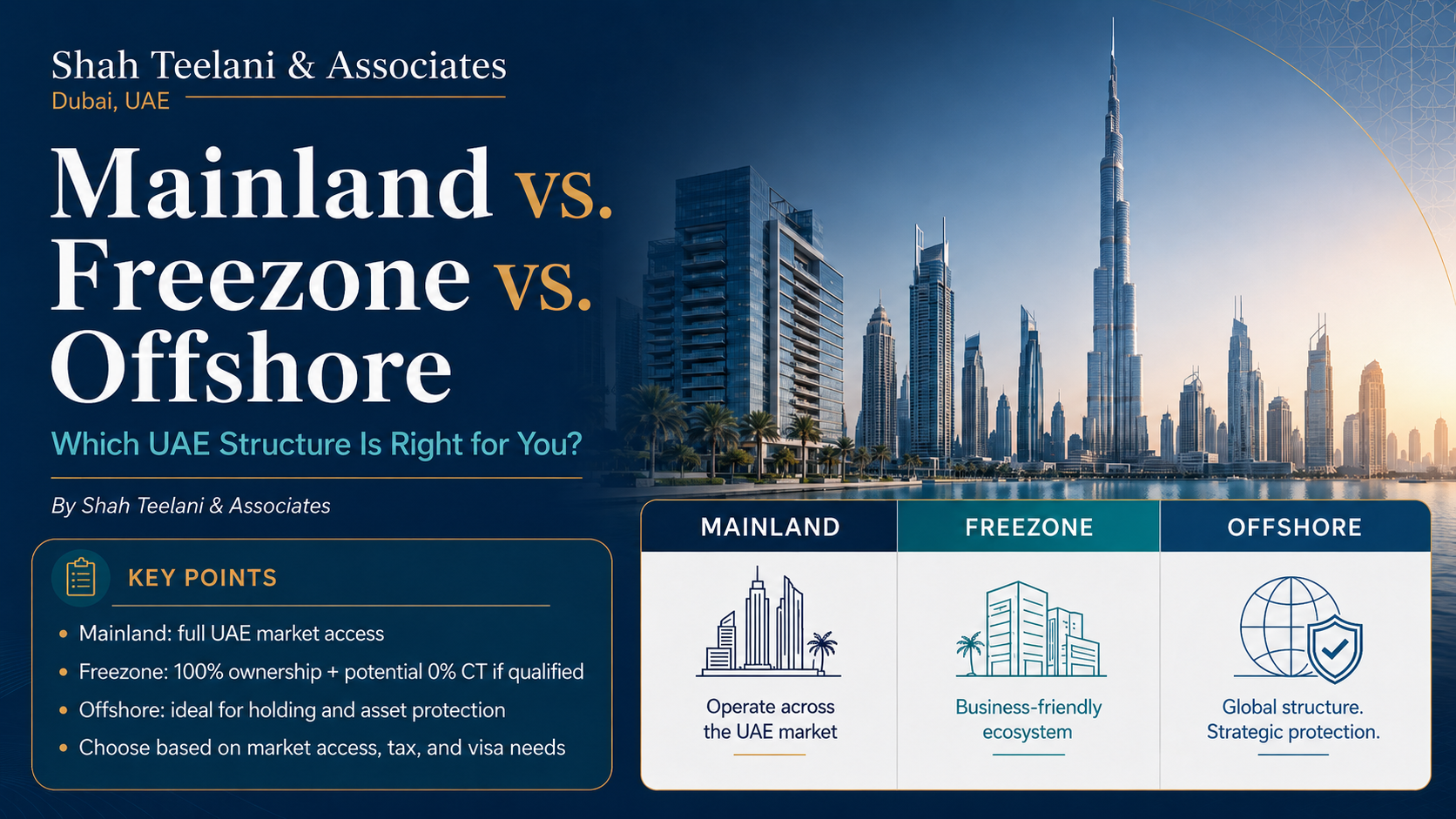
4. Plan for mainland access if you need it.
Several freezones, including DMCC, now offer dual-license arrangements that allow operation on the UAE mainland without a local sponsor — a meaningful consideration if your customer base extends beyond freezone and international clients.
How Shah Teelani & Associates Can Help
Choosing among the top freezones in UAE involves more than comparing license fees. Specifically, it requires evaluating your sector, banking strategy, Corporate Tax position, and long-term growth plans together.
At Shah Teelani & Associates, we help businesses:
- Select the freezone best aligned with their activity and growth plans
- Assess QFZP eligibility before incorporation
- Structure dual-license and holding company arrangements
- Navigate banking relationships across Tier 1 and Tier 2 zones
If you are evaluating freezone options for a new or existing UAE entity, contact Shah Teelani & Associates today.
Shah Teelani & Associates | inquiry@shahteelani.com
