


By Shah Teelani & Associates | Dubai, UAE
When setting up a business in the UAE, entrepreneurs must first resolve one foundational question: which legal structure suits their goals? Specifically, the choice between mainland, freezone, and offshore UAE structures shapes everything — from tax exposure and ownership rights to the customers you can legally serve. In contrast to markets where one standard company form covers most situations, the UAE offers three distinct paths, each with its own commercial logic.
This guide breaks down all three so you can choose with confidence.
Mainland vs Freezone vs Offshore UAE: The Core Difference
Before diving into each structure, it helps to understand what separates them at a fundamental level:
- Mainland entities operate under a DED (Department of Economic Development) license and can trade freely within the UAE.
- Freezone entities operate under a freezone authority license and are primarily designed for international or export-facing business.
- Offshore entities are legal vehicles incorporated in the UAE but prohibited from conducting business within it.
Consequently, the right choice depends entirely on where your customers are, what you sell, and whether you need a UAE presence in the physical sense.
Mainland
A mainland company obtains its license from the Department of Economic Development (DED) of the relevant emirate. Importantly, mainland entities can trade anywhere in the UAE — including directly with government bodies and retail consumers — without restriction.
Key features:
- 100% foreign ownership now permitted across most business activities, following the 2021 Companies Law reforms
- Operations from any physical location across the UAE
- Ability to directly bid on government contracts and public tenders
- No artificial restriction on visa quotas relative to office space (subject to emirate-specific rules)
- Subject to UAE Corporate Tax at 9% on taxable income exceeding AED 375,000, effective June 2023
For official UAE Corporate Tax guidance, refer to the Federal Tax Authority.
Best for: Businesses that serve the UAE local market directly, work with government entities, or need unrestricted commercial presence across all seven emirates.
Freezone
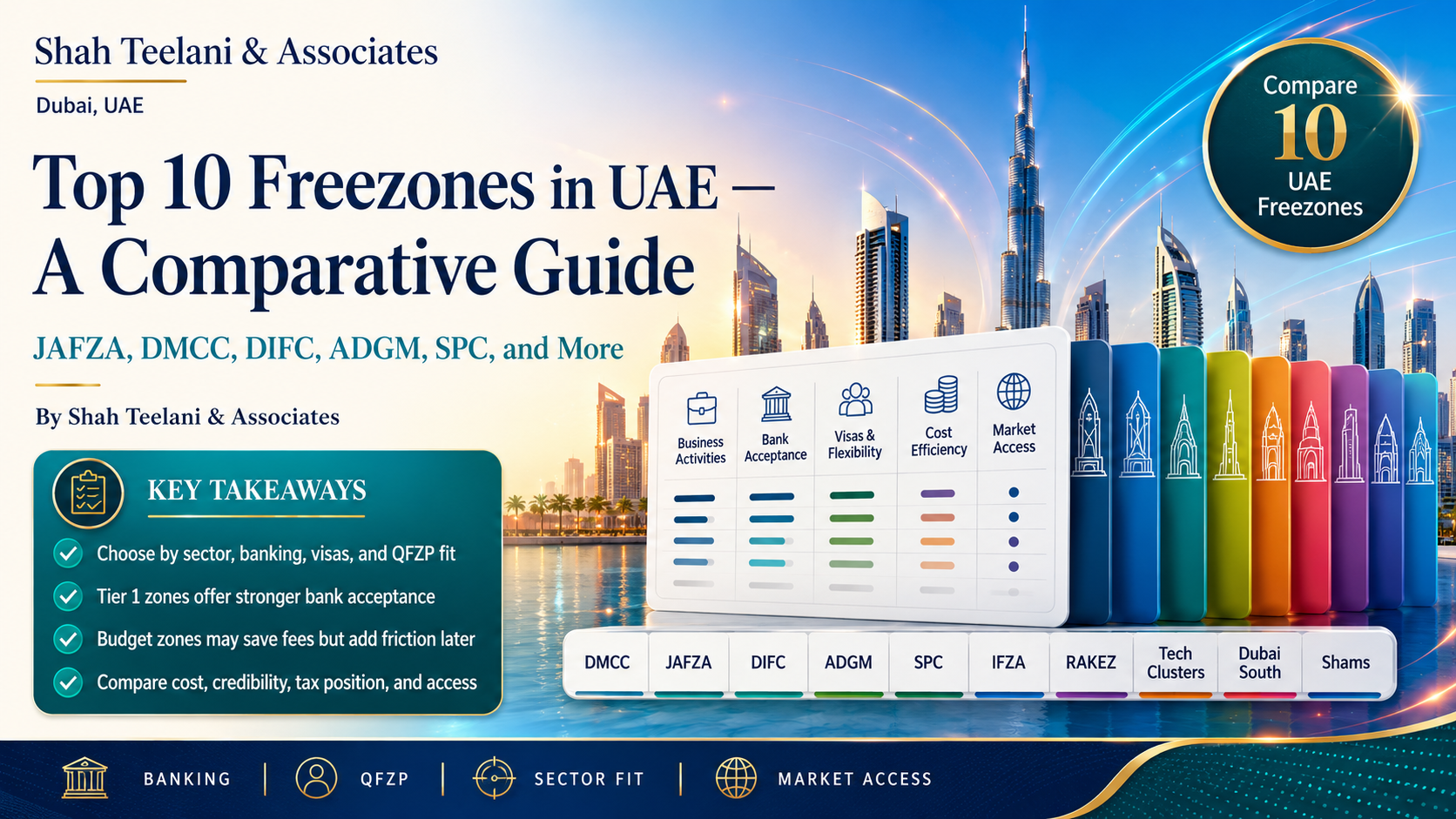
The UAE currently hosts over 40 freezones — including DIFC, ADGM, JAFZA, DMCC, and Dubai Silicon Oasis — each regulated by its own authority and tailored to specific sectors. In contrast to mainland entities, freezone companies operate under the freezone authority’s licensing regime rather than the DED.
Key features:
- 100% foreign ownership, a longstanding feature predating the mainland reform
- No restriction on profit repatriation or capital transfers
- Customs duty exemptions within the freezone perimeter
- Direct trade with the UAE mainland market requires either a local distributor or a dual-license arrangement (rules vary by freezone)
- Eligible for the 0% Corporate Tax rate if the entity qualifies as a Qualifying Free Zone Person (QFZP) under the UAE CT Law — subject to substance requirements and the 95% qualifying income threshold
- Each freezone carries its own cost structure, minimum capital requirements, and office or flexi-desk rules
Best for: International businesses, service exporters, trading companies, holding structures, and any operation where UAE mainland market access is not the primary commercial objective.
Offshore
Offshore entities — primarily RAK ICC and JAFZA Offshore — incorporate in the UAE but cannot conduct business within it. Accordingly, offshore structures serve a fundamentally different purpose from mainland or freezone entities: they function as holding and asset-protection vehicles rather than operating companies.
Key features:
- No physical presence requirement and no UAE trade license
- JAFZA Offshore entities can hold Dubai freehold real estate — a notable exception to general offshore limitations
- No UAE residence visa sponsorship through the entity itself
- Low ongoing maintenance cost relative to mainland and freezone options
- No Corporate Tax filing obligations in the typical operational sense — though tax advice based on where economic substance sits remains essential
- High confidentiality relative to other structures
Best for: Asset protection, IP ownership, estate planning, international holding structures, and real estate holding where UAE residency or local market access is not required.
Side-by-Side Comparison
| Mainland | Freezone | Offshore | |
|---|---|---|---|
| UAE market access | ✅ Unrestricted | ⚠️ Limited / Indirect | ❌ Not permitted |
| Foreign ownership | ✅ 100% (most activities) | ✅ 100% | ✅ 100% |
| UAE residence visa | ✅ Yes | ✅ Yes | ❌ Generally No |
| Corporate Tax | 9% above AED 375K | 0% if QFZP-qualified | Typically N/A |
| Physical office required | ✅ Yes | Flexi-desk or office | ❌ No |
| Government contracts | ✅ Yes | ❌ No | ❌ No |
| Primary use case | Local operations | International / export | Holding / IP / Asset |
Choosing Between Mainland, Freezone, and Offshore in the UAE
To make this decision well, start with three questions:
1. Who are your customers? If your customers are primarily UAE-based businesses or consumers, mainland gives you the cleanest and most direct access. If, instead, your customers sit outside the UAE or in international markets, a freezone typically costs less and delivers greater tax efficiency.
2. Do you need a UAE residence visa? Offshore entities generally cannot sponsor residence visas. Both mainland and freezone entities can. Consequently, if UAE residency is a personal or operational requirement, offshore immediately narrows out as a standalone solution.
3. What is the nature of your income? If you want to benefit from the freezone 0% Corporate Tax rate, your income must satisfy the Qualifying Income test and your entity must maintain adequate economic substance in the UAE. Furthermore, structuring decisions you make at formation carry Corporate Tax consequences for years afterward — restructuring later is possible but always costly.
Ultimately, there is no universally best structure. A holding company may rationally sit offshore while its operating subsidiary sits in a freezone. Meanwhile, a business serving retail clients across Dubai may have no practical alternative to a mainland license.
Common Mistakes to Avoid
Choosing a freezone purely for cost, without checking CT eligibility. Many businesses set up in a freezone expecting 0% Corporate Tax, then later discover their income does not qualify as Qualifying Income or their substance fails the test. As a result, they end up taxed at 9% despite the freezone label.
Using an offshore entity as an operating company. Offshore entities cannot invoice UAE clients, cannot obtain a UAE trade license, and cannot sponsor employees. Therefore, using one as an operating vehicle creates both legal and tax compliance risk.
Ignoring mainland reforms. Since the 2021 Companies Law changes, 100% foreign ownership on mainland is available for most activities. In contrast to common perception, mainland is no longer automatically more expensive or restrictive than freezone for foreign investors.
How Shah Teelani & Associates Can Help
We advise businesses at the formation stage and after the fact — reviewing existing structures, identifying Corporate Tax exposure, assessing QFZP eligibility, and aligning your legal form with your actual commercial and tax position.
Specifically, our advisory team works across mainland, freezone, and offshore structures, including dual-license arrangements and holding company design for UAE and cross-border groups.
If you are evaluating a new setup or reviewing an existing one, contact us.
Shah Teelani & Associates | 219, Al Goze Building, Dubai, UAE | info@shahteelani.com
