




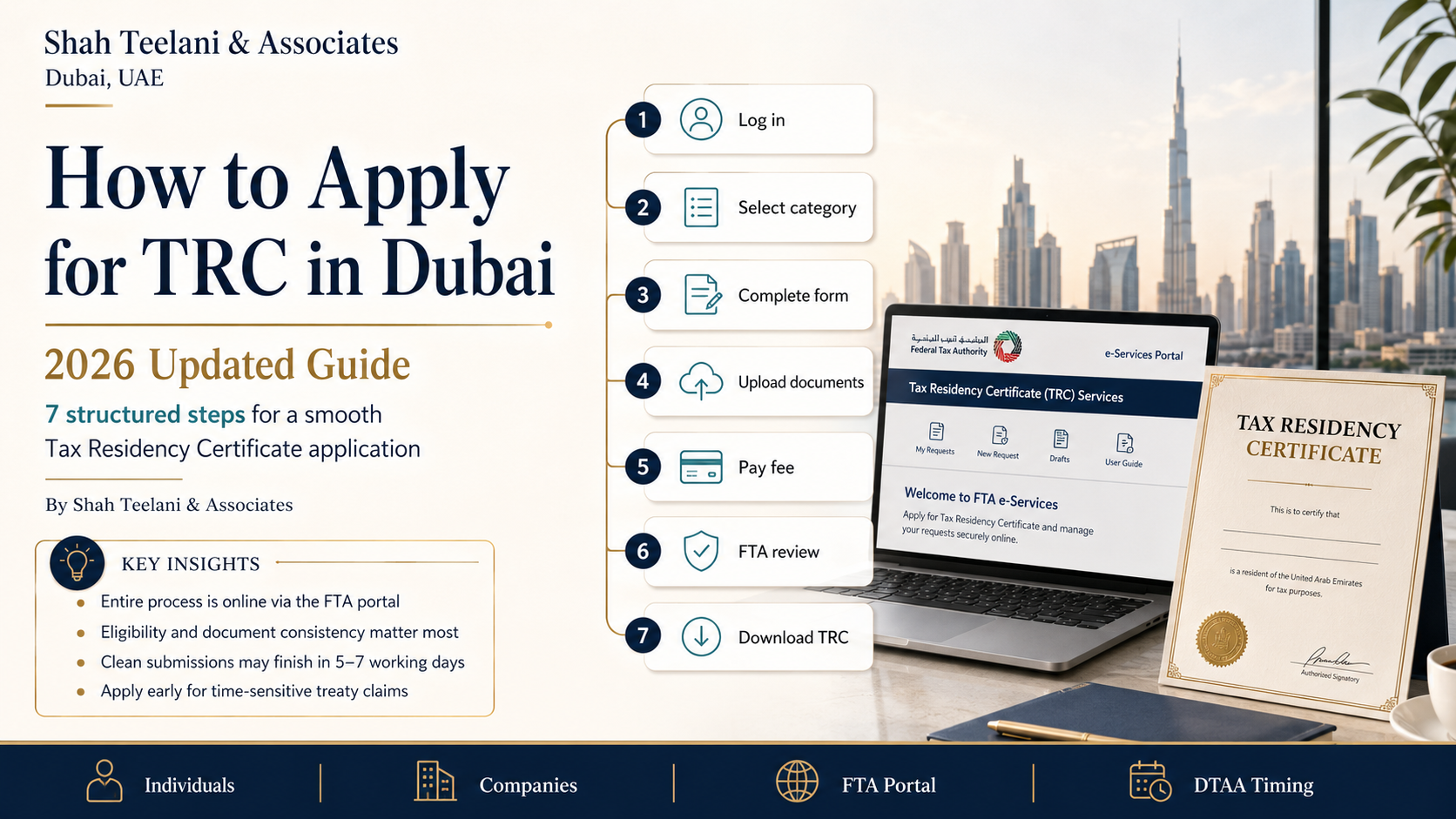
By Shah Teelani & Associates | Dubai, UAE
Indian residents who relocate to Dubai often continue investing in Indian mutual funds, equity markets, and other domestic financial instruments. However, once tax residency shifts to the UAE, the taxation framework governing those investments changes significantly. Specifically, obtaining a TRC in Dubai for Indian residents becomes a critical step for properly claiming India–UAE tax treaty benefits and avoiding unintended double taxation.
This guide explains how a Tax Residency Certificate works specifically for Indian residents investing in mutual funds, how capital gains are currently taxed under the India–UAE framework, and when you should consider applying.
Why TRC in Dubai Matters for Indian Mutual Fund Investors
When an Indian individual becomes a UAE tax resident but continues holding or redeeming Indian mutual funds, two jurisdictions become relevant simultaneously:
- India — the source country of the investment income
- UAE — the country of tax residence
Under the India–UAE Double Taxation Avoidance Agreement (DTAA), taxation rights are allocated between the two countries. However, Indian tax authorities and financial institutions typically require documentary proof of UAE tax residency before applying treaty provisions. Consequently, this is precisely where a TRC issued by the Federal Tax Authority becomes essential.
Current Taxation of Indian Mutual Funds for UAE Residents (FY 2025-26)
Tax treatment depends entirely on the type of fund and the holding period. The figures below reflect the rules effective for FY 2025-26 (AY 2026-27).
1. Capital Gains on Equity Mutual Funds
Equity-oriented funds — those investing at least 65% in domestic equity shares — follow Section 111A and Section 112A of the Income Tax Act:
- Short-Term Capital Gains (STCG) — units redeemed within 12 months are taxed at 20%
- Long-Term Capital Gains (LTCG) — units held over 12 months are taxed at 12.5% on gains exceeding ₹1.25 lakh per financial year, with no indexation benefit available
Importantly, the treaty does not automatically eliminate Indian capital gains tax on Indian securities — India retains primary taxing rights on gains from Indian-source equity regardless of residency. However, establishing UAE residency through a TRC can:
- Formally document NRI classification under the Indian Income Tax Act
- Avoid global income classification disputes
- Reduce the risk of dual tax claims arising from ambiguous residency status
This becomes particularly relevant once an individual’s residential status under Indian tax law shifts to Non-Resident Indian (NRI).
2. Debt Mutual Funds and Hybrid Funds
Following the Finance Act 2023 changes, debt mutual fund units purchased on or after 1 April 2023 lose long-term capital gains treatment entirely. Instead, gains are taxed at the investor’s applicable income slab rate, regardless of holding period.
Accordingly, for UAE residents, correct residency classification becomes especially important here — since slab-rate application depends heavily on accurate NRI documentation. A TRC strengthens this documentation and helps ensure correct withholding treatment by Indian fund houses.
3. Dividend Income from Mutual Funds
Dividends from Indian mutual funds remain taxable in India in the hands of the investor. However, incorrect residential classification can lead to:
- Higher withholding tax than the applicable treaty rate
- Administrative complications with fund houses
- Banking compliance queries during repatriation
Submitting a valid TRC helps Indian intermediaries correctly apply NRI taxation rules instead of resident slab rates — directly affecting the amount withheld at source.
Key Situations Where Indian Investors in Dubai Need a TRC
You should strongly consider obtaining a TRC if:
- You have shifted permanently to Dubai but still hold Indian mutual funds
- You plan to redeem large investments that will trigger significant capital gains
- Indian authorities have requested tax residency proof
- You want to formally document your NRI tax status
- You are restructuring your investment holdings across jurisdictions
For high-value redemptions — particularly those involving long-term capital gains above the ₹1.25 lakh exemption threshold — documentation clarity carries direct financial significance.
Residential Status Under Indian Tax Law vs. UAE Residency
Becoming a UAE resident does not automatically mean Indian tax authorities treat you as a non-resident. Instead, India determines residential status based on:
- Physical stay in India (number of days during the financial year)
- Income thresholds under deemed residency provisions
- Specific deemed residency rules applicable to certain high-income individuals
If ambiguity exists, Indian authorities may question residency claims directly. Consequently, a TRC issued by the UAE acts as:
- Independent, government-backed proof of foreign tax residency
- Supporting documentation during scrutiny or assessment
- Defensive evidence in the event of a dual residency dispute
Large Portfolio Investors and HNIs — Special Considerations
For high-net-worth individuals holding large equity mutual fund portfolios, Portfolio Management Services (PMS) structures, Alternative Investment Funds (AIFs), or direct equity investments, tax residency documentation becomes even more important during:
- Exit events and large block transactions
- Capital gains planning ahead of redemptions
- Wealth restructuring across jurisdictions
In such cases, a TRC functions as more than a procedural formality — it forms part of structured, defensible cross-border tax planning.
Practical Example
An Indian entrepreneur relocates to Dubai in April 2025 and qualifies as a UAE tax resident. In March 2026, he redeems ₹3 crore worth of equity mutual funds in India.
Without proper residency documentation: Indian authorities may scrutinise his residential status, questions may arise regarding global income classification, and compliance scrutiny risk increases substantially.
With a TRC: UAE residency is formally documented, NRI status is strengthened, and the treaty position becomes defensible from the outset.
Given that the LTCG exemption is only ₹1.25 lakh, the vast majority of a ₹3 crore redemption would face the 12.5% LTCG rate regardless — making accurate NRI classification and correct TDS application financially material at this scale.
Common Misunderstandings Among Indian Investors
Many investors assume:
- “If I live in Dubai, I don’t need any tax certificate.”
- “India cannot tax my investments once I move.”
- “My NRE/NRO account classification is sufficient on its own.”
In reality, none of these assumptions hold up under scrutiny. Specifically:
- Tax residency must be formally documented, not merely implied by relocation
- India retains the right to tax Indian-source capital gains regardless of where you live
- Treaty access requires formal proof — it is never automatically granted
Accordingly, a TRC helps investors avoid incorrect assumptions that often lead to compliance complications later, sometimes years after the original redemption.
Interaction With Indian Banks and Fund Houses
Indian mutual fund houses and custodians routinely request:
- Updated KYC documentation reflecting overseas residency
- NRI status confirmation
- Overseas address proof
- Tax residency documentation supporting treaty claims
Providing a TRC enhances compliance clarity, supports smoother redemption processing, and reduces administrative friction — particularly for investors executing frequent transactions or large-value redemptions.
When a TRC May Not Be Immediately Necessary
You may not require a TRC if:
- Investment values are minimal and unlikely to trigger meaningful scrutiny
- No redemptions are currently planned
- No foreign authority has requested documentation
- Residential status is already clearly non-resident under Indian rules with no ambiguity
However, for serious investors managing meaningful portfolios, proactive documentation generally remains the more strategically sound approach.
Strategic Takeaway for Indian Mutual Fund Investors in Dubai
For Indian residents who have shifted to Dubai and continue investing in Indian mutual funds, TRC in Dubai for Indian residents plays a targeted and practical role. Specifically, it:
- Supports correct NRI tax classification
- Strengthens your treaty-based tax position under the India–UAE DTAA
- Reduces dual taxation risk on cross-border capital gains
- Protects high-value capital gains events from documentation disputes
- Enhances overall compliance credibility with Indian fund houses and tax authorities
Ultimately, in cross-border investing, documentation strength often determines tax certainty.
How Shah Teelani & Associates Can Help
Investing in Indian mutual funds while residing in Dubai is common — but taxation depends heavily on documented residency status, not assumption.
At Shah Teelani & Associates, we help Indian investors in the UAE:
- Assess TRC eligibility and prepare a complete FTA application
- Document NRI status correctly for Indian fund houses and tax authorities
- Plan large redemptions and exit events with treaty positioning in mind
- Navigate the interaction between Indian capital gains rules and UAE tax residency
If you are managing significant Indian mutual fund holdings, planning redemptions, or restructuring your investment portfolio, contact Shah Teelani & Associates to discuss your TRC application.
Key Takeaways
- A TRC in Dubai for Indian residents formally documents UAE tax residency and supports India–UAE DTAA treaty claims
- Indian equity mutual funds remain taxed in India at 20% (STCG) or 12.5% above ₹1.25 lakh (LTCG) for FY 2025-26, regardless of UAE residency
- Debt mutual funds purchased after April 2023 are taxed at slab rates with no long-term benefit
- A TRC does not eliminate Indian tax on Indian-source income — it supports correct NRI classification and treaty application
- High-value redemptions and HNI portfolios carry the greatest financial exposure to incorrect documentation
- Proactive TRC planning before a redemption event is significantly more effective than reactive documentation after scrutiny begins
Shah Teelani & Associates | inquiry@shahteelani.com
