




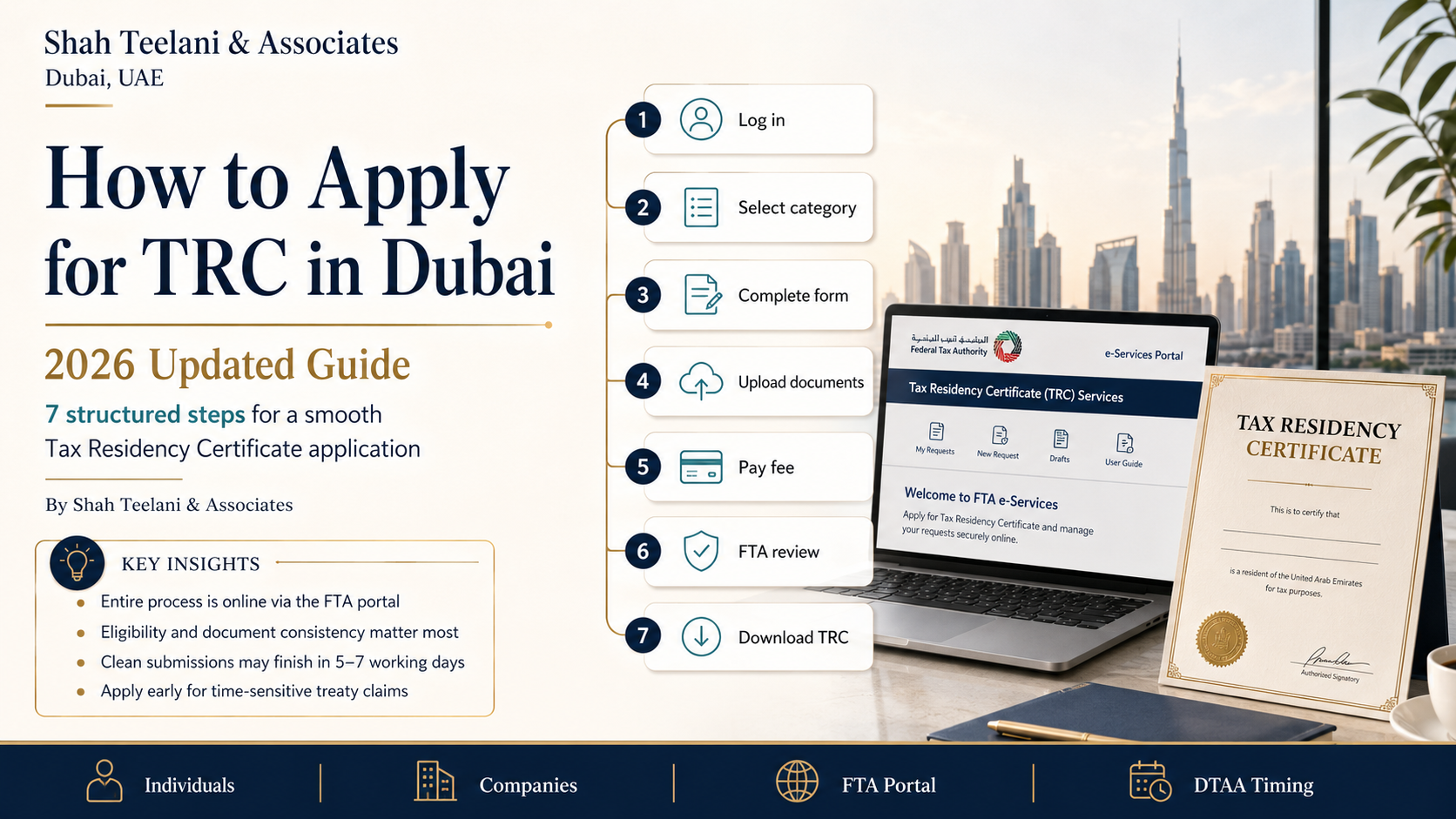
By Shah Teelani & Associates | Dubai, UAE
For individuals and companies earning income between India and the UAE, TRC in Dubai for India UAE DTAA claims sit at the center of every treaty benefit decision. The Double Taxation Avoidance Agreement between the two countries plays a decisive role in determining where tax is payable — but treaty benefits are never automatic. Specifically, to formally claim reduced tax rates or exemptions, a UAE resident must provide official proof of tax residency, and that proof is precisely what makes TRC in Dubai for India UAE DTAA claims foundational rather than optional.
This guide explains how a Tax Residency Certificate enables DTAA claims, which income categories are most affected, and what Indian and UAE tax authorities expect in terms of documentation and compliance.
Why TRC in Dubai for India UAE DTAA Claims Are Mandatory
Under Section 90 of the Indian Income Tax Act, a taxpayer claiming relief under a tax treaty must submit a Tax Residency Certificate from the contracting state where they reside. Importantly, this requirement is mandatory, not discretionary.
Without a valid TRC, the following consequences typically apply:
- Standard domestic Indian withholding tax rates apply instead of treaty-reduced rates
- Reduced withholding rates may be denied at source by Indian payers
- Treaty exemption claims may be rejected during assessment or scrutiny
- Indian tax filings as a non-resident may be challenged
Consequently, the TRC functions as the foundational compliance document for anyone invoking the treaty. No other document — including an Emirates ID, UAE visa, or bank statements — substitutes for it in formal treaty proceedings. This is exactly why TRC in Dubai for India UAE DTAA documentation cannot be treated as an afterthought.
Key DTAA Articles Where TRC Becomes Critical
The treaty allocates taxation rights across multiple income categories. Below are the primary provisions where TRC submission becomes operationally important.
1. Dividend Income (Article 10)
Dividends paid by Indian companies to UAE resident shareholders attract Indian withholding tax. Under the treaty, this rate is capped at 10% of the gross dividend amount — but only when the TRC has been submitted alongside beneficial ownership confirmation.
Indian companies typically require the following before applying the treaty rate:
- A valid UAE Tax Residency Certificate covering the relevant financial year
- Form 10F, as prescribed under Indian tax law
- A declaration of beneficial ownership
Without a TRC, dividend payments default to the full domestic rate, significantly increasing the tax cost for UAE-resident shareholders.
2. Interest Income (Article 11)
Interest earned on loans, bonds, fixed deposits, or other financial instruments sourced from India is subject to Indian withholding tax. The treaty prescribes reduced rates for eligible UAE residents:
- 5% of the gross interest amount where the interest is paid on a loan granted by a bank or similar financial institution conducting bona fide banking business
- 12.5% of the gross interest amount in all other cases
Accordingly, for UAE-resident lenders or investors holding Indian debt instruments, submitting a TRC ensures the treaty rate applies at source rather than the higher domestic rate.
3. Royalties and Technical Service Fees (Article 12)
Cross-border royalty payments, software licensing fees, and technical service charges between Indian and UAE entities represent a growing and commercially significant category.
India typically imposes withholding tax on such payments. Claiming treaty-reduced rates requires:
- A valid UAE TRC
- A beneficial ownership declaration
- Appropriate contractual documentation establishing the nature of services rendered
For businesses engaged in intellectual property licensing, software exports, or consulting arrangements with Indian clients, this provision can materially affect net cash flows and overall project economics.
4. Business Profits (Article 7)
Under the treaty, the business profits of a UAE-resident enterprise are taxable only in the UAE unless the enterprise maintains a Permanent Establishment (PE) in India. This represents one of the treaty’s most commercially valuable provisions for UAE-based service providers and consulting firms.
To assert this position effectively with Indian counterparties and tax authorities, a TRC helps establish:
- UAE tax residency of the enterprise
- Treaty entitlement to Article 7 protection
- Non-resident classification under Indian income tax law
In cross-border service contracts, especially where Indian clients are required to deduct tax at source, the TRC often determines whether withholding applies at all.
5. Capital Gains (Article 13)
Capital gains taxation under the treaty depends on several factors, including the nature of the asset, its location, and the entity type involved. Notably, India retains taxing rights in certain situations — for example, on gains from shares of Indian companies.
However, proper residency documentation remains essential to:
- Establish treaty status and access Article 13 provisions
- Avoid residential classification disputes with Indian authorities
- Support accurate non-resident tax filings in India
A TRC materially strengthens the treaty-based position in capital gains scenarios, particularly for UAE residents managing high-value Indian equity portfolios, real estate interests, or business exit transactions.
Corporate vs. Individual Claims: How TRC in Dubai for India UAE DTAA Differs
Both individuals and companies can invoke treaty benefits, but the compliance pathways differ considerably.
Individual claimants typically seek treaty relief on salary income from Indian employers, consulting or freelance income paid by Indian clients, investment income including dividends, interest, and capital gains, and rental income from Indian properties.
Corporate claimants most commonly invoke treaty benefits for intercompany service payments and management fees, cross-border technical services and consulting contracts, royalty and intellectual property licensing arrangements, and financing structures involving cross-border lending.
In corporate transactions, treaty rate application typically occurs at source — meaning Indian payers deduct withholding tax before remitting payment. Therefore, TRC submission must occur before payment processing to avoid the need for subsequent refund claims.
How Indian Tax Authorities Evaluate DTAA Claims
Indian tax authorities have become increasingly rigorous in evaluating treaty claims, particularly following the OECD’s Base Erosion and Profit Shifting (BEPS) initiatives. Importantly, a TRC is necessary but not always sufficient on its own.
Key evaluation criteria include:
- A valid TRC covering the relevant Indian financial year (April to March)
- Beneficial ownership of the income being claimed under the treaty
- Economic substance of UAE residency, including physical presence, business activity, and decision-making
- Absence of treaty abuse or artificial arrangements
The treaty includes anti-abuse provisions aligned with international BEPS standards. Consequently, obtaining a TRC without genuine economic substance in the UAE may not guarantee treaty relief if the overall arrangement is challenged as lacking commercial reality.
TRC and Form 10F: The Required Compliance Combination
For claiming treaty benefits, a TRC alone is typically insufficient under Indian law. Indian regulations additionally require Form 10F, which captures:
- The taxpayer’s nationality
- Tax identification number in the country of residency
- The period of residency covered
- The address in the country of residency during the relevant period
Since 2022, Form 10F must be filed electronically on India’s income tax portal. Accordingly, failure to file Form 10F electronically can invalidate treaty claims even where a valid TRC exists. Both documents must be in order before treaty rates apply or before Indian tax filings are made.
Common Scenarios Requiring TRC in Dubai for India UAE DTAA Claims
The following situations most frequently require a TRC for treaty claims between the two countries:
- Receiving dividend income from Indian public or private companies
- Providing advisory, consulting, or professional services to Indian clients
- Licensing software, patents, or other intellectual property into India
- Earning interest income from Indian loans, bonds, or fixed deposits
- Structuring cross-border business contracts with Indian counterparties
- Filing Indian income tax returns as a non-resident claiming treaty relief
- Managing high-value Indian equity or mutual fund portfolios from Dubai
In each of these situations, treaty rates and benefits apply only with proper and timely documentation. Retroactive treaty claims remain possible but involve refund filings, longer processing timelines, and increased audit risk.
Practical Illustration
Consider a Dubai-based consultancy firm providing strategic advisory services to an Indian corporate client. Under the service agreement, the Indian company must deduct withholding tax at source.
Without treaty documentation: Withholding applies at the standard domestic Indian rate, typically 10–20% depending on the service category, significantly reducing the net amount remitted to the UAE firm.
With TRC and Form 10F submitted before payment: The applicable treaty rate applies instead, reducing withholding tax, improving cash flow, and eliminating the need for refund filings. Across multiple contracts over a financial year, this financial impact can become substantial.
Anti-Abuse and Economic Substance Considerations
Modern treaty interpretation has evolved significantly. Indian tax authorities, guided by BEPS Action Plans and domestic General Anti-Avoidance Rules (GAAR), evaluate whether treaty claims reflect genuine economic arrangements.
Key concepts influencing treaty claim evaluation include:
- Principal Purpose Test (PPT): If one of the principal purposes of an arrangement is to obtain treaty benefits, relief may be denied
- Beneficial ownership: Income must be genuinely owned by the UAE resident, not held as an agent or conduit
- Substance-over-form analysis: UAE residency must reflect real commercial activity, not merely a tax-motivated relocation
A TRC should therefore form part of a broader, compliant cross-border structure — not a standalone tactic. Taxpayers with genuine UAE residence, substantive business operations, and defensible commercial arrangements are best positioned to benefit from treaty provisions.
Why Timely TRC Application Matters
A critical and frequently overlooked requirement is that the TRC must be valid at the time of income receipt and, ideally, submitted before withholding occurs. Specifically:
- The TRC must cover the relevant Indian financial year (April to March)
- It must be valid at the time the income is received or the transaction is completed
- Indian payers typically require TRC submission before processing payments at treaty rates
Applying for a TRC after tax has already been deducted at the domestic rate requires filing a refund claim in India, which involves additional time, administrative effort, and scrutiny risk. Proactive documentation significantly reduces compliance burden and improves cash flow certainty.
Strategic Importance for High-Value Transactions
For high-net-worth individuals, family offices, and businesses engaged in significant cross-border transactions, TRC-backed treaty planning offers material financial advantages:
- Reduced withholding tax on investment income improves net returns
- Treaty-based protection for business profits minimises Indian tax exposure on service income
- Clear allocation of taxing rights reduces the risk of double taxation on the same income
- Well-documented treaty positions are more defensible during scrutiny or assessment
- Consistent compliance establishes credibility with Indian tax authorities over time
For businesses planning major exit events, block transactions, or restructuring involving Indian assets, coordinating TRC timing with transaction execution carries particular importance.
How Shah Teelani & Associates Can Help
Securing TRC in Dubai for India UAE DTAA benefits requires more than treaty eligibility — it requires formal, documented proof of UAE tax residency, submitted at the right time and in the correct format.
At Shah Teelani & Associates, our qualified CPAs and international tax professionals provide:
- TRC eligibility assessment and FTA application management
- Form 10F preparation and electronic filing coordination
- Article-specific treaty positioning for dividends, interest, royalties, and business profits
- Economic substance and beneficial ownership documentation review
- End-to-end support for high-value transactions, exits, and restructuring involving Indian assets
If you are claiming or planning to claim treaty benefits between India and the UAE, contact Shah Teelani & Associates to ensure your TRC and supporting documentation are correctly structured.
Key Takeaways
- TRC in Dubai for India UAE DTAA claims are mandatory under Section 90 of the Indian Income Tax Act — not optional or discretionary
- Treaty rates cap dividend withholding at 10%, interest at 5% (bank loans) or 12.5% (other cases), and provide specific relief for royalties and business profits
- A TRC alone is insufficient — Form 10F must also be filed electronically on India’s income tax portal
- BEPS-aligned anti-abuse rules mean genuine economic substance in the UAE matters as much as the certificate itself
- Timing is critical — TRC submission before payment avoids the need for refund claims after the fact
- High-value transactions, exits, and restructuring carry the greatest financial exposure to incorrect or late documentation
Shah Teelani & Associates | inquiry@shahteelani.com
