


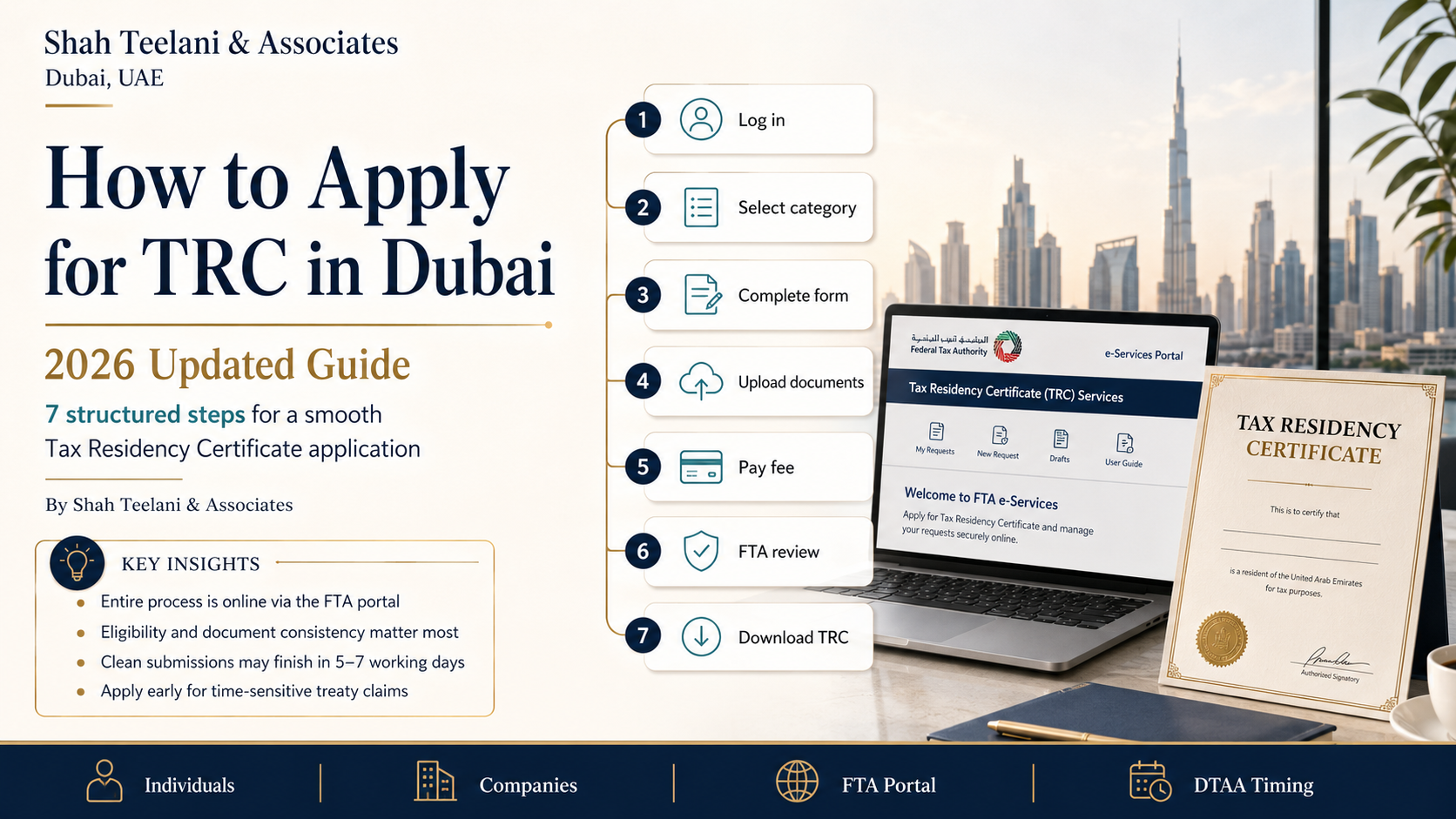
As cross-border investments and international income streams become standard for UAE residents and businesses, one document consistently determines whether treaty benefits apply or get denied: the Tax Residency Certificate UAE (TRC). Specifically, a TRC confirms your tax residency status to foreign authorities, banks, and regulators — and without it, you may pay significantly more tax than the law requires.
In this guide, Shah Teelani & Associates covers everything you need to know about obtaining a UAE Tax Residency Certificate, including what it is, why it matters, what documents you need, and the most common reasons applications get rejected.
What Is a Tax Residency Certificate UAE?
A Tax Residency Certificate is an official document issued by a country’s tax authority confirming that an individual or entity qualifies as a tax resident of that country for a specific financial year. In the UAE, the Federal Tax Authority (FTA) issues TRCs to both individuals and companies.
Consequently, a UAE TRC allows holders to:
- Claim benefits under Double Taxation Avoidance Agreements (DTAA) that the UAE maintains with over 130 countries
- Avoid being taxed twice on the same income — including dividends, interest, royalties, and professional fees
- Prove UAE tax residency to foreign tax authorities, international banks, and overseas regulators
Without a valid Tax Residency Certificate, UAE residents and businesses lose access to these treaty protections entirely.
Why Is a UAE Tax Residency Certificate Required?
1. Claiming DTAA Benefits
The most common reason to obtain a tax residency certificate UAE is to activate treaty benefits. Specifically, DTAA provisions allow you to:
- Apply reduced withholding tax rates on income earned abroad
- Claim full or partial tax exemptions on qualifying income categories
- Avoid dual taxation on the same income stream across two jurisdictions
2. Overseas Investments and International Income
Foreign jurisdictions frequently require a TRC when you:
- Invest in shares, bonds, or funds outside the UAE
- Receive rental income from property in another country
- Earn professional fees, consultancy income, or royalties from international clients
3. Banking and Financial Compliance
Banks and financial institutions request a tax residency certificate for:
- Opening or maintaining overseas bank accounts
- Processing large international remittances
- KYC verification and AML compliance requirements
4. Regulatory and Immigration Purposes
Additionally, certain government bodies and overseas regulators require a TRC to confirm an individual’s residency status or a company’s operational substance in the UAE.
Types of UAE Tax Residency Certificate
Individual TRC
The UAE FTA issues individual TRCs to UAE resident individuals, including expatriates, based on physical presence and residency conditions. Accordingly, applicants must demonstrate genuine residence — not merely a visa stamp.
Corporate TRC
The FTA issues corporate TRCs to UAE-registered companies. In contrast to individual applications, corporate TRCs require proof of economic substance, genuine operational activity, and active banking relationships.
Documentation Required for a UAE Tax Residency Certificate
For Individuals
To obtain a tax residency certificate UAE as an individual, you must typically provide:
- Passport copy
- UAE residence visa
- Emirates ID
- Entry and exit movement report (from GDRFA or ICP)
- Tenancy contract (Ejari-registered)
- Utility bill confirming UAE address
- Salary certificate or income proof
- Bank statements covering at least six months
For Companies
Corporate applicants must typically submit:
- Trade license (valid and current)
- Memorandum and Articles of Association
- Shareholder passport copies
- Office lease agreement
- Audited financial statements
- Bank statements
- Economic substance compliance evidence where applicable
Important: Documentation requirements vary depending on the treaty country for which the TRC is being used and the specific DTAA provisions involved. Consequently, a document set that works for one country’s tax authority may be insufficient for another.
Common Mistakes That Lead to TRC Rejection
Despite meeting eligibility criteria, many UAE TRC applications get rejected or delayed due to avoidable errors. Understanding these risks in advance significantly improves approval outcomes.
1. Insufficient Physical Presence
For individual applications, failing to meet the minimum residency days threshold is the most common rejection ground. Specifically, applicants who hold a UAE visa but spend most of their time abroad frequently fail this test.
2. Incomplete or Mismatched Documents
Furthermore, even complete document sets can trigger rejection if:
- Bank statements do not reflect income claims
- Address details are inconsistent across different documents
- Tenancy or utility proof is missing, outdated, or unregistered
3. Lack of Economic Substance for Companies
Corporate applications face rejection when the entity shows signs of being a shell company — specifically, no real office, no active employees, inactive bank transactions, or no demonstrable management and control in the UAE.
4. Incorrect Financial Statements
Unaudited financials, statements covering the wrong reporting period, or figures that contradict bank records all raise red flags. Accordingly, financial statements must be audit-ready and accurately reflect the period for which the TRC applies.
5. Improper Application Structuring
Many applicants submit documents without proper context, supporting notes, or treaty alignment. As a result, reviewers cannot connect the documentation to the specific treaty benefit being claimed — and reject the application even when the underlying documents exist and are valid.
Consequences of a Rejected TRC Application
A rejected or incorrectly structured TRC application carries real financial and compliance consequences:
- Loss of DTAA benefits — treaty protections do not apply retroactively once income has been taxed abroad
- Higher withholding taxes — foreign payers deduct tax at the standard rate rather than the treaty rate
- Delays in overseas investments — foreign counterparties and banks place transactions on hold
- Increased scrutiny — repeated rejection flags your file with the FTA for future applications
- Elevated compliance costs — correcting rejected applications requires additional professional fees and time
Ultimately, the cost of a rejected TRC almost always exceeds the cost of getting professional help before filing.
Why Professional Assistance Matters for UAE TRC Applications
A Tax Residency Certificate is not merely a document submission. In contrast to routine government filings, a TRC application is a tax residency assessment — and the FTA evaluates substance, consistency, and treaty alignment, not just paperwork.
At Shah Teelani & Associates, our team of qualified CPAs and international tax professionals:
- Assesses eligibility before filing to identify risks in advance
- Reviews and structures documentation to match FTA and treaty requirements
- Identifies potential red flags — such as residency day shortfalls or substance gaps — before submission
- Aligns your application with the specific DTAA provisions you intend to use
- Manages the end-to-end TRC application process with the FTA on your behalf
Specifically, we handle TRC engagements for UAE resident individuals, foreign investors, and multinational businesses operating across multiple jurisdictions.
How Shah Teelani & Associates Can Help
Our TRC advisory services include:
- TRC eligibility assessment for individuals and companies
- Individual and corporate TRC filing with the FTA
- Documentation review, gap analysis, and preparation
- Audit-ready financial statement support
- DTAA advisory and cross-border tax planning
- End-to-end compliance support throughout the application process
If you need a UAE Tax Residency Certificate or want to ensure your existing application is accurate, complete, and rejection-proof, contact Shah Teelani & Associates today.
Key Takeaways
- A tax residency certificate UAE is issued by the FTA and confirms individual or corporate tax residency for a specific year
- TRCs are essential for claiming DTAA benefits, managing overseas income, and satisfying banking compliance requirements
- Individual applications require physical presence evidence; corporate applications require economic substance proof
- The most common rejection causes are insufficient residency days, document mismatches, shell company indicators, and poor application structuring
- A rejected TRC creates real financial consequences — including loss of treaty benefits and higher withholding taxes abroad
- Professional structuring of the application significantly reduces rejection risk
Shah Teelani & Associates | info@shahteelani.com
