


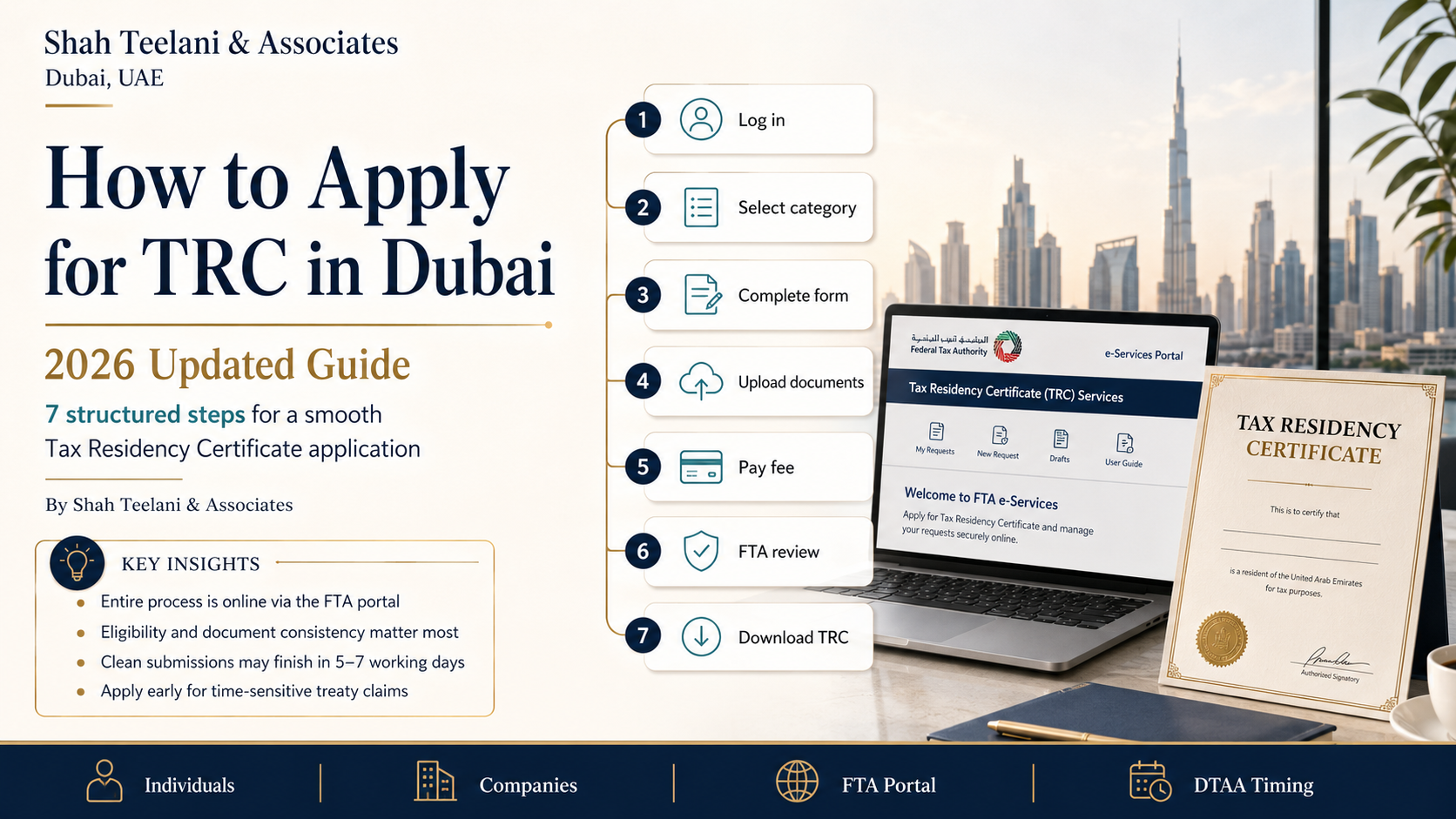
As global mobility rises and cross-border income becomes standard for expatriates, investors, and businesses, one document increasingly determines whether international tax benefits apply or get denied: the Tax Residency Certificate Dubai. Specifically, a TRC issued by the UAE confirms your tax residency status to foreign authorities, banks, and treaty partners — and without it, you may lose access to significant bilateral tax protections.
In this guide, Shah Teelani & Associates explains what a tax residency certificate Dubai is, why it matters in today’s global economy, who typically needs one, and what it does — and does not — do for your tax position.
What Is a Tax Residency Certificate Dubai?
A Tax Residency Certificate (TRC) is an official document issued by the Federal Tax Authority (FTA) of the UAE. Specifically, it confirms that an individual or corporate entity qualifies as a tax resident of the UAE for a defined financial year.
In practical terms, the UAE tax residency certificate serves three core functions:
- Legal proof of UAE tax residency for a specific period
- A supporting document to claim benefits under Double Taxation Avoidance Agreements (DTAAs)
- Evidence required by foreign tax authorities, overseas banks, and international financial institutions
Crucially, the TRC does not create tax residency on its own. Instead, it certifies that the applicant already satisfies the UAE’s tax residency conditions under applicable regulations. Consequently, eligibility must be established before the application is filed — not assumed.
Why Tax Residency Matters in the Global Economy
Tax residency determines where a person or company is liable to pay taxes. In cross-border situations, more than one country may assert taxing rights over the same income — resulting in double taxation, where identical income faces tax in two separate jurisdictions simultaneously.
To prevent this, countries enter into Double Taxation Avoidance Agreements. The UAE maintains an extensive DTAA network spanning over 130 countries, making a tax residency certificate Dubai strategically valuable for:
- Claiming relief and reduced rates under applicable UAE DTAAs
- Reducing withholding taxes on foreign-source income such as dividends, interest, and royalties
- Establishing and formally documenting primary tax residency status
- Satisfying international compliance and documentation requirements
Furthermore, as global tax reporting standards tighten through frameworks such as the Common Reporting Standard (CRS) and FATCA, formal residency documentation has moved from optional to essential. For globally active individuals and businesses, a TRC is now a cornerstone of responsible international financial planning.
How the TRC Fits Into Dubai’s Tax Framework
Dubai’s tax framework has evolved considerably with the introduction of UAE Corporate Tax and heightened global transparency standards. Within this landscape, the tax residency certificate Dubai functions as:
- A formal confirmation of tax residence, recognized internationally by treaty partners
- A compliance instrument for cross-border transactions and regulatory reporting
- A structured mechanism to access bilateral treaty benefits under applicable DTAAs
Importantly, a TRC is not about avoiding taxes. Instead, it ensures that taxation occurs in the correct jurisdiction, in accordance with recognized international agreements and bilateral treaty provisions. Accordingly, it strengthens rather than circumvents compliance.
Who Needs a Tax Residency Certificate in Dubai?
While not mandatory for all UAE residents, a tax residency certificate Dubai is particularly relevant for the following groups:
Expatriate Professionals
Individuals earning income from overseas investments, dividends, consulting arrangements, or remote work situations who need to formally confirm their primary tax residence in the UAE.
Investors and High-Net-Worth Individuals
Investors holding positions in global markets, mutual funds, or foreign securities who must establish UAE tax residency to access treaty-reduced withholding rates on investment income.
Entrepreneurs and Consultants
Professionals operating across multiple jurisdictions who must document their primary tax residence for compliance, banking, and cross-border tax planning purposes.
Corporate Entities
Companies engaged in cross-border trade, licensing arrangements, royalty payments, or international service agreements that require formal residency certification from the UAE FTA.
Each situation requires careful evaluation against UAE tax residency rules and the specific provisions of the relevant treaty. Consequently, a one-size-fits-all approach to TRC applications carries real risk.
What a Tax Residency Certificate Is NOT
To avoid costly misunderstandings, it is equally important to clarify what a Dubai tax residency certificate does not represent:
- It is not a tax exemption certificate
- It does not automatically eliminate foreign tax liability
- It is not permanent — it applies to a specific financial year only
- It does not override economic substance requirements or local compliance obligations in other jurisdictions
Key point: The TRC is a supporting compliance document — not a standalone tax shield. Its value lies in working alongside applicable tax treaties and residency regulations, not in replacing them.
When Should You Apply for a Tax Residency Certificate Dubai?
You should consider obtaining a tax residency certificate Dubai if any of the following apply:
- A foreign tax authority or overseas institution has requested proof of your UAE tax residency
- You are claiming treaty benefits or reduced withholding rates under a UAE DTAA
- You receive foreign-source income subject to withholding tax in another country
- You are restructuring your personal or corporate tax residency arrangements
- You operate internationally and need formal residency certification for banking or regulatory compliance
Furthermore, timing matters. Specifically, a TRC issued for a particular financial year cannot apply retroactively beyond its validity period. Consequently, forward planning is essential — waiting until a foreign authority demands the certificate often results in lost treaty benefits for the period already elapsed.
Strategic Importance of the Dubai TRC for International Planning
The benefits of a tax residency certificate Dubai extend well beyond routine documentation. For internationally active individuals and entities, a TRC directly supports:
- Efficient international tax structuring aligned with DTAA provisions
- Reduced foreign withholding taxes on dividends, interest, and royalties
- A stronger compliance position with overseas tax authorities and regulators
- Enhanced credibility with international banks and financial institutions
Additionally, as CRS and FATCA reporting obligations expand globally, formal residency documentation strengthens financial transparency. For expatriates in particular, a valid TRC can directly determine access to Dubai tax benefits under applicable bilateral treaties — making it a proactive planning tool rather than a reactive compliance fix.
TRC as Part of Responsible Tax Compliance
The global tax environment increasingly emphasises transparency, economic substance, and clear residency determination. Accordingly, forward-thinking individuals and businesses treat the tax residency certificate Dubai not as a procedural formality but as:
- A strategic compliance instrument for international tax planning
- A cross-border tool to access DTAA benefits effectively and defensibly
- A safeguard against unintended double taxation and treaty disputes
In contrast to the misconception that a TRC is simply an administrative step, it is ultimately a substantive assessment of your tax residency position — and the FTA evaluates applications accordingly.
How Shah Teelani & Associates Can Help
Obtaining a tax residency certificate Dubai involves more than submitting documents. Specifically, the FTA assesses physical presence, economic substance, document consistency, and treaty alignment — and applications that fall short on any of these dimensions face rejection.
At Shah Teelani & Associates, our qualified CPAs and international tax professionals provide:
- TRC eligibility assessment before filing
- Individual and corporate TRC application management
- Documentation review, gap analysis, and preparation
- DTAA advisory and cross-border tax planning
- End-to-end FTA compliance support
If you need a tax residency certificate Dubai or want to confirm your eligibility before applying, contact Shah Teelani & Associates today.
Key Takeaways
- A tax residency certificate Dubai is issued by the UAE FTA and confirms individual or corporate tax residency for a specific financial year
- It does not create tax residency — it certifies that residency conditions are already met
- The TRC is essential for claiming DTAA benefits, managing overseas income, and satisfying international banking and compliance requirements
- It is not a tax exemption and does not override substance or compliance obligations in other jurisdictions
- Timing matters — a TRC cannot apply retroactively, so forward planning is critical
- Professional structuring of the application significantly reduces rejection risk
Shah Teelani & Associates | 219, Al Goze Building, Dubai, UAE | info@shahteelani.com
