


By Shah Teelani & Associates | Dubai, UAE
As international investments, remote work, and cross-border business activity continue to grow, tax residency has become a decisive factor in determining where income gets taxed. For residents and companies operating in Dubai, understanding the purpose of TRC in Dubai is essential — because while many people know what a Tax Residency Certificate is, fewer fully grasp why it matters or what it practically unlocks.
This guide focuses specifically on the purpose of TRC in Dubai, explaining why individuals and businesses need one and what real advantages it delivers.
What Is the Primary Purpose of a TRC in Dubai?
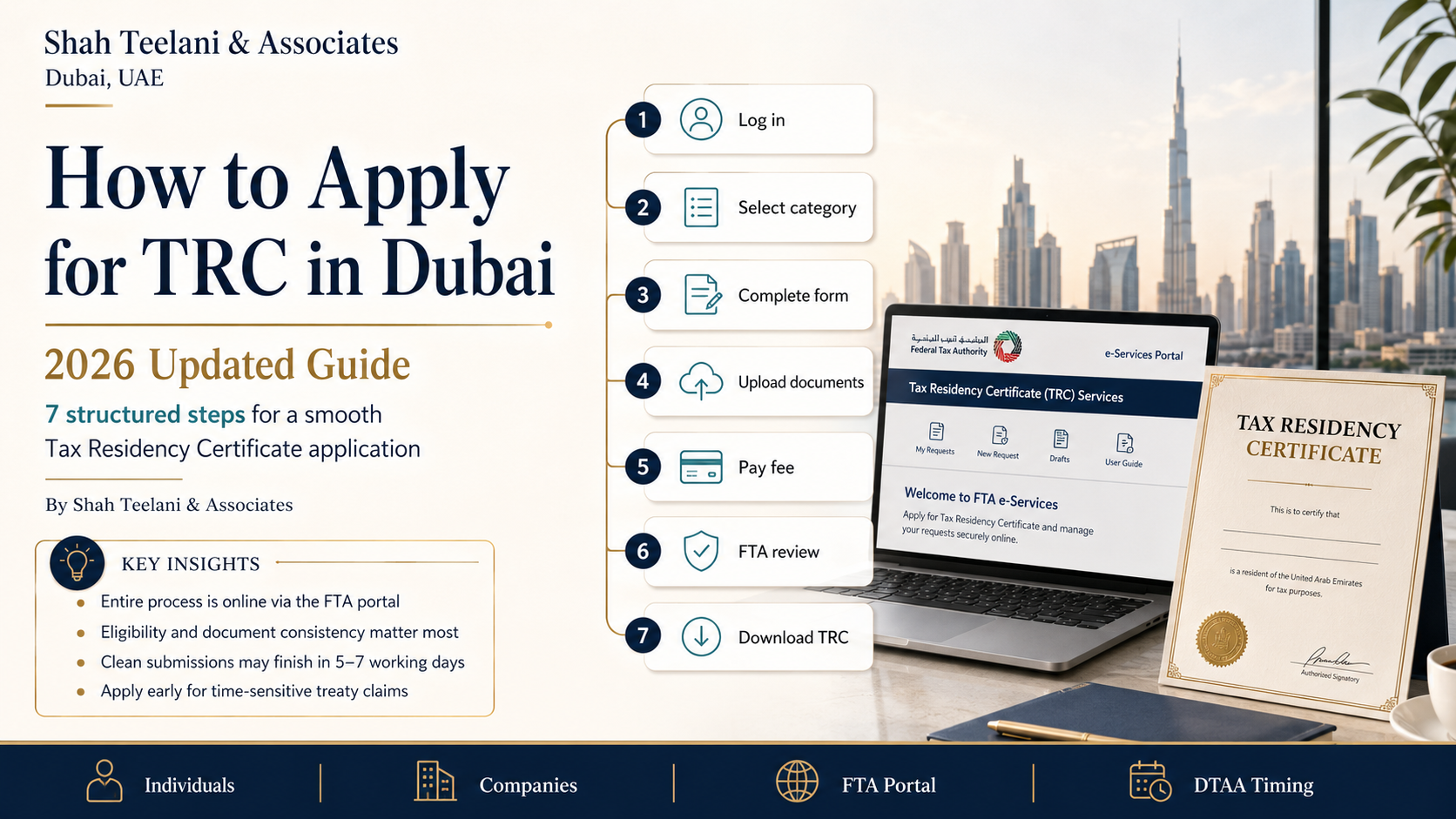
The Federal Tax Authority (FTA) issues the Tax Residency Certificate as official confirmation that an individual or company qualifies as a UAE tax resident for a specific financial year.
At its core, the purpose of TRC in Dubai is to:
- Establish formal tax residency status recognised under international law
- Enable access to Double Taxation Avoidance Agreements (DTAAs) signed by the UAE
- Prevent double taxation on the same income across two jurisdictions
- Provide official documentation to foreign tax authorities, banks, and financial institutions
In short, the TRC exists to ensure taxation rights apply correctly — in the right country, under the right treaty provisions.
7 Key Reasons You Need a Tax Residency Certificate in Dubai
1. To Avoid Double Taxation
One of the primary reasons individuals and companies apply for a TRC is to prevent being taxed twice on the same income — a genuine risk in cross-border financial situations.
Specifically, in international scenarios, one country may assert taxing rights based on residence, while another claims them based on income source. Without treaty protection, both can tax the same earnings simultaneously.
The UAE maintains an extensive DTAA network. Consequently, with a valid TRC, taxpayers can:
- Claim reduced withholding tax rates under applicable treaties
- Obtain exemptions where treaty provisions allow
- Formally demonstrate primary tax residence to foreign authorities
2. To Claim Treaty Benefits Under DTAAs
The UAE has signed tax treaties with numerous jurisdictions worldwide — but treaty benefits are not automatically granted. Instead, foreign tax authorities routinely require official proof before applying reduced rates or exemptions.
Typically, they ask for:
- Official proof of tax residency from the home country
- A government-issued residency certificate
- Confirmation of the financial year the certificate covers
The tax residency certificate Dubai serves as precisely this official proof. Without it, treaty relief claims may be delayed, disputed, or rejected entirely.
3. To Reduce Withholding Tax on Foreign Income
Many countries impose standard withholding taxes on outbound income — including dividends, interest, royalties, and professional service fees. These rates can be substantial. However, bilateral tax treaties frequently reduce them significantly for qualifying residents.
For instance, if a UAE resident receives dividend income from a foreign company, the source country may apply a reduced treaty withholding rate — but only once a valid TRC is submitted as proof of UAE tax residency.
Accordingly, this represents one of the most tangible, financially impactful elements of the purpose of TRC in Dubai — directly lowering the tax cost on foreign-source income.
4. To Provide Proof of Tax Residency to Banks and Financial Institutions
As global compliance standards tighten under frameworks such as the Common Reporting Standard (CRS) and FATCA, banks and financial institutions increasingly require formal tax residency documentation before processing cross-border transactions, opening accounts, or maintaining investment relationships.
A Dubai residency certificate for tax purposes provides:
- Official government validation of UAE tax residence
- Stronger compliance positioning in international financial dealings
- Reduced documentation disputes and onboarding delays
For high-net-worth individuals, globally active professionals, and corporate treasury teams, this documentation has become operationally essential.
5. To Support International Investment Structures
Investors with diversified global portfolios often require formal residency certification when structuring or managing:
- Foreign mutual fund investments
- Offshore holding companies or special purpose vehicles
- International capital gains subject to treaty treatment
- Cross-border business entities and joint ventures
In such cases, a TRC strengthens the legal and compliance foundation of the investment structure — demonstrating that tax residency claims rest on recognised international standards rather than assumptions.
6. To Establish Primary Tax Residence
For expatriates who previously lived in another country, maintain financial ties abroad, or are actively restructuring their personal tax affairs, clearly establishing primary tax residence is often non-negotiable.
A TRC formally documents that the UAE is the individual’s primary tax residence for the relevant financial year — a critical safeguard when foreign tax authorities challenge or question residency claims. Without it, disputes become difficult and costly to resolve.
7. To Strengthen Corporate Cross-Border Transactions
For companies operating internationally, the purpose of TRC in Dubai extends to a wide range of business-to-business scenarios, including:
- Cross-border licensing and intellectual property arrangements
- Royalty and fee agreements with foreign subsidiaries or partners
- International service contracts where withholding tax applies
- Intercompany transactions subject to transfer pricing and treaty rules
Many foreign jurisdictions require a valid residency certificate before applying reduced treaty withholding rates. Therefore, for businesses, this is not merely a compliance formality — it directly impacts profitability, cash flow, and tax efficiency.
What the TRC Is NOT Intended For
Understanding the boundaries of the purpose of TRC in Dubai is equally important. Specifically, the TRC:
- Does not automatically eliminate foreign tax liability
- Does not guarantee treaty approval — substance and eligibility conditions still apply
- Is not a substitute for economic substance compliance
- Is issued for a specific financial year only — it is not a permanent document
Key reminder: The TRC supports treaty application — it does not function as a blanket tax exemption. Its power lies in working alongside applicable international agreements, not replacing them.
When Do You Actually Need a TRC?
Not every UAE resident requires a TRC. However, you should strongly consider applying if any of the following apply:
- A foreign country or authority has formally requested proof of your UAE tax residency
- You are claiming treaty benefits or reduced rates under a UAE DTAA
- You receive foreign-source income subject to withholding tax in another country
- You operate across multiple jurisdictions and need formal residency documentation
- You are restructuring your personal or corporate tax residency arrangements
If any of these scenarios apply, obtaining a TRC proactively — rather than reactively — is the more strategically sound approach.
Why the Purpose of TRC in Dubai Is Strategic, Not Procedural
Many people initially view the TRC as simply another government certificate to collect. In reality, it functions as a strategic compliance tool with measurable financial and legal implications.
In today’s global tax environment — where transparency, documentation, and residency clarity face rigorous scrutiny — the TRC:
- Enhances tax planning certainty across jurisdictions
- Protects proactively against double taxation risk
- Supports structured and defensible international financial planning
- Improves cross-border credibility with tax authorities and financial institutions
Ultimately, obtaining a TRC is a proactive compliance decision — not merely a reactive administrative requirement triggered by a foreign authority’s request.
How Shah Teelani & Associates Can Help
Understanding the purpose of TRC in Dubai is the first step. Applying correctly is the part that determines whether you actually receive the treaty protection you need.
At Shah Teelani & Associates, our qualified CPAs and international tax professionals provide:
- TRC eligibility assessment for individuals and companies
- Application preparation aligned with specific DTAA provisions
- Documentation review to prevent rejection or delay
- End-to-end FTA filing support
- Ongoing DTAA and cross-border tax planning advisory
If you need a Tax Residency Certificate or want to confirm your eligibility before applying, contact Shah Teelani & Associates today.
Key Takeaways
- The purpose of TRC in Dubai is to formally establish UAE tax residency and unlock DTAA treaty protections
- It directly reduces withholding tax on foreign-source income such as dividends, interest, and royalties
- Banks and financial institutions increasingly require it for cross-border compliance under CRS and FATCA
- It is not a tax exemption and does not eliminate foreign tax liability automatically
- A TRC applies to a specific financial year only — proactive planning matters more than reactive filing
- Both individuals and companies benefit — from expatriate professionals to corporations managing cross-border transactions
Shah Teelani & Associates | inquiry@shahteelani.com
