


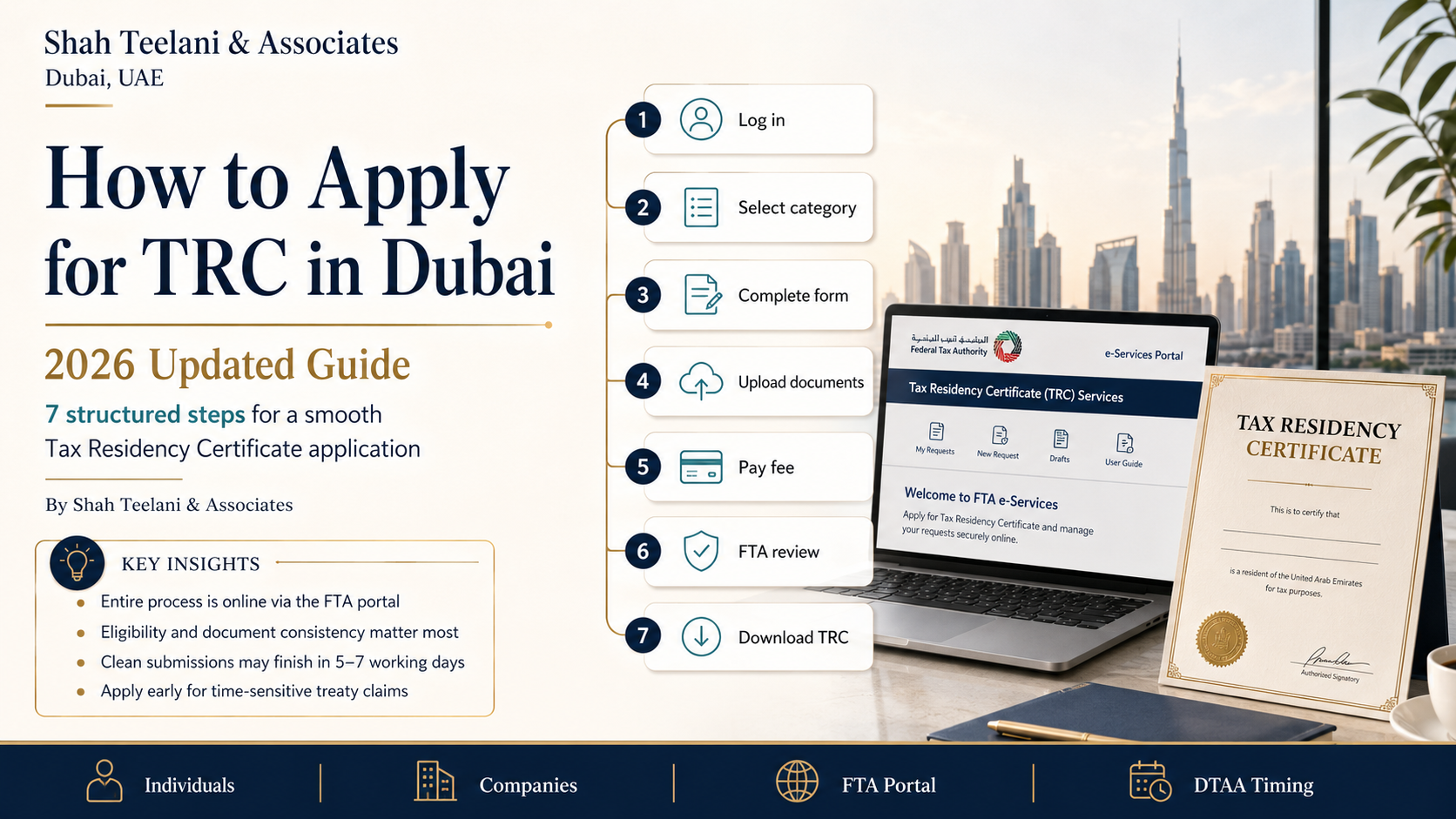
| Individuals applying for a Tax Residency Certificate (TRC) in Dubai must submit a specific set of documents to the UAE Federal Tax Authority to verify their tax residency status. Proper documentation is the foundation of a successful TRC application — incomplete, inconsistent, or poorly prepared documents are among the most common reasons for delays and rejections. This guide explains exactly what documents are required, what each document must demonstrate, and how to prepare and present your application file for the best chance of approval. |
Introduction
After confirming eligibility for a UAE Tax Residency Certificate (TRC), the next step is preparing the documentation required for submission to the Federal Tax Authority (FTA).
Because the certificate may later be relied upon by foreign tax authorities, financial institutions, and treaty partners, the documentation submitted must be clear, complete, and internally consistent. Preparing the required documents carefully before submitting the application significantly reduces the risk of delays, additional information requests, or rejection.
This guide explains the key documents required for an individual TRC application in Dubai, what each document demonstrates, and how applicants should prepare their submission to ensure a smooth approval process.
Why Documentation Is the Foundation of a Successful TRC Application
When an individual submits a TRC application to the Federal Tax Authority, the FTA must independently verify several interconnected facts:
- That the applicant is who they claim to be — confirmed through identity documents
- That the applicant holds valid UAE legal residency status — confirmed through visa and Emirates ID
- That the applicant was physically present in the UAE for the required period — confirmed through immigration movement records
- That the applicant genuinely lives in the UAE — confirmed through residential address documentation
- That the applicant’s economic activity is connected to the UAE — confirmed through bank statements and employment or income evidence
Each of these verification points corresponds directly to the eligibility criteria established under UAE Cabinet Decision No. 85 of 2022. The documents submitted must not only be individually valid but must also be internally consistent with one another — the name on the passport must match the Emirates ID, the address on the tenancy contract must align with the address on the bank statements, and the physical presence evidence must be consistent with the residency period claimed.
Incomplete or inconsistent documentation is the most frequent cause of TRC application delays, additional information requests from the FTA, and outright rejections. Investing time in proper document preparation before submitting the application is therefore the most effective way to ensure a smooth and timely outcome.
Key Documents Required for Individual TRC Applications in Dubai
The following documents are required for individuals applying for a Tax Residency Certificate in Dubai. Each document serves a specific verification purpose, and the quality and completeness of each submission matters.
1. Passport Copy
A clear, legible copy of the applicant’s valid passport is required as the primary identity and nationality verification document. The passport copy must include:
- All personal information pages — including the biographical data page showing the applicant’s full name, date of birth, nationality, and passport number
- The passport validity period, confirming that the document was valid during the financial year to which the TRC application relates
- Relevant entry and exit stamp pages, where requested, to provide supplementary evidence of UAE presence — particularly useful for applicants whose immigration movement reports require corroboration
The passport must be valid at the time of application. If the passport expired during the relevant financial year and was subsequently renewed, copies of both the expired and renewed passport may be required to provide continuity of identity verification. All pages must be scanned clearly, with no portions cropped or obscured.
2. UAE Residence Visa
A copy of the applicant’s valid UAE residence visa is mandatory for every individual TRC application. The UAE residence visa is the legal instrument that confirms the applicant’s right to reside in the UAE, and it must be valid during the financial year for which the TRC is being requested.
Acceptable UAE residence visa categories for TRC purposes include:
- Employment residence visa — sponsored by a UAE-based employer and tied to an active employment contract
- Investor or partner visa — held by business owners and company shareholders with active UAE commercial interests
- Freelance visa — issued to self-employed professionals and independent contractors working through a licensed freelance permit
- Golden Visa — the UAE’s long-term residency visa, valid for five or ten years, available to qualifying investors, entrepreneurs, skilled professionals, and exceptional talents
- Dependent or family visa — for spouses and dependants of UAE residents, provided the applicant also satisfies the physical presence and other eligibility conditions in their own right
Tourist visas, visit visas, and transit permits are not acceptable for TRC applications and will result in automatic rejection. The visa copy must show the visa issue date, expiry date, sponsor details, and visa type clearly. A visa that was valid during the relevant year but has since expired at the time of application should be supplemented with the renewed visa if applicable.
3. Emirates ID Copy
A copy of the applicant’s valid Emirates ID — the national identity card issued to all UAE residents by the Federal Authority for Identity, Citizenship, Customs and Port Security (ICP) — is a standard mandatory requirement for individual TRC applications.
The Emirates ID copy must:
- Be valid at the time of application
- Show both the front and back of the card clearly, including the applicant’s name, ID number, nationality, date of birth, and expiry date
- Be fully consistent with the details on the passport and residence visa — any discrepancies in name spelling or identification numbers must be resolved before submitting the application
The Emirates ID serves as the applicant’s official UAE identification document and is cross-referenced against other submitted documents during the FTA’s verification process. An expired Emirates ID, or one that was not renewed promptly after expiry, may create gaps in the residency evidence record and should be renewed before the TRC application is submitted.
4. UAE Entry and Exit Report
The UAE entry and exit report — an official immigration movement record issued by the Federal Authority for Identity, Citizenship, Customs and Port Security (ICP) — is one of the most critical documents in the individual TRC application. It provides the primary objective evidence of the applicant’s physical presence in the UAE during the relevant period.
The entry and exit report typically shows:
- The exact dates of every entry into the UAE and every departure from the UAE during the requested period
- The total number of days spent within the UAE, calculated from the recorded movements
- The port or border crossing used for each entry and exit
The report allows the Federal Tax Authority to verify the applicant’s physical presence in the UAE during the relevant period and confirm the residency claim made in the TRC application.
The report can be obtained through the ICP’s official portal and should cover the full period relevant to the TRC application.
5. UAE Bank Statements
Bank statements from a UAE-licensed financial institution are required to demonstrate the applicant’s financial activity and economic presence within the UAE during the relevant period. The FTA typically requests statements covering the most recent six months prior to the application, though statements covering the full financial year or the period to which the TRC relates may also be required depending on the applicant’s profile.
The bank statements should demonstrate:
- Regular and meaningful financial transactions conducted within the UAE — including salary credits, bill payments, local purchases, and utility debits
- That the applicant’s primary day-to-day financial activity is anchored in the UAE
- Evidence of UAE-sourced income or economic activity, such as employer salary transfers, rental income receipts, or business payment flows
Bank statements must be official documents obtained directly from the bank — either as printed statements bearing the bank’s official stamp and letterhead, or as digitally certified electronic statements. Manually edited statements, partial extracts, or screenshots from mobile banking applications are generally not acceptable and may result in rejection or a request for re-submission.
6. Proof of Residential Address in the UAE
Documentary evidence of the applicant’s residential address in the UAE is required to confirm that the applicant genuinely lives in the country, rather than merely holding a visa while residing primarily elsewhere. This is an important distinction: the FTA is assessing genuine habitation, not simply legal permission to reside.
Acceptable residential address documents include:
- A tenancy contract registered with the relevant real estate authority — in Dubai, this means an Ejari-registered lease agreement; in Abu Dhabi, a Tawtheeq-registered contract; in other Emirates, the equivalent registered tenancy document
- A title deed or proof of property ownership in the UAE, for applicants who own their UAE residence
- Utility bills in the applicant’s name and at the UAE residential address, such as DEWA (Dubai Electricity and Water Authority), ADDC, or equivalent utility provider invoices
The address shown on the residential documentation must be consistent with the address recorded on the Emirates ID and the address reflected in the bank statements. An Ejari-registered tenancy contract is the strongest and most widely accepted form of residential address evidence for Dubai applicants, as it is a government-registered document that independently confirms both the address and the tenancy relationship.
Hotel accommodation, serviced apartments, or temporary lodging without a formal registered tenancy are generally insufficient to satisfy this requirement. Applicants living in employer-provided accommodation should ensure they have documentation in their own name confirming the arrangement.
7. Salary Certificate or Employment and Income Evidence
Evidence of the applicant’s employment status or income-generating activity in the UAE is typically required as part of the TRC documentation package. The specific documents required depend on the applicant’s employment or business profile:
For Employed Individuals
A salary certificate or employment confirmation letter issued by the UAE employer is the standard required document. This letter should be on the employer’s official letterhead and include:
- The applicant’s full name and position within the organisation
- The name and details of the UAE-registered employer
- Confirmation of employment status (permanent, contract, or part-time)
- The applicant’s monthly salary or compensation package
- The date of joining and, where applicable, the duration of the employment contract
For Self-Employed Individuals, Freelancers, and Business Owners
Applicants who are self-employed, operate as freelancers, or own UAE-registered businesses should provide alternative documentation demonstrating their professional and commercial activity in the UAE. This may include:
- A copy of the UAE trade licence or freelance permit in the applicant’s name
- Active client contracts or service agreements demonstrating ongoing commercial activity
- Invoices or payment records evidencing income received from UAE or international clients
- A letter from the applicant’s accountant or auditor confirming the nature and level of business activity during the relevant period
For high-net-worth individuals or investors who do not have traditional employment income, documentation demonstrating investment activity — such as portfolio statements, dividend records, or property income evidence — may be submitted to support the economic presence component of the application.
Individual TRC Document Checklist at a Glance
The table below provides a complete reference summary of all documents required for an individual TRC application in Dubai, including the specific detail required for each document and its mandatory status:
| Document | Specification / Detail Required | Status | |
|---|---|---|---|
| ✓ | Passport Copy | Clear copy of all personal information pages; relevant entry/exit stamp pages | Mandatory — core identity document |
| ✓ | UAE Residence Visa | Valid visa covering the relevant financial year; employment, investor, freelance or golden visa | Mandatory — confirms legal residency status |
| ✓ | Emirates ID Copy | Valid Emirates ID matching passport and visa details | Mandatory — UAE national identity verification |
| ✓ | UAE Entry & Exit Report | Official immigration movement report showing all UAE entry and exit dates and total days present | Mandatory — primary physical presence evidence |
| ✓ | UAE Bank Statements | Statements from a UAE-licensed bank covering the last 6 months showing regular transactional activity | Mandatory — demonstrates economic presence |
| ✓ | Proof of Residential Address | Ejari-registered tenancy contract, rental agreement, or property ownership document | Mandatory — confirms genuine UAE habitation |
| ✓ | Employment / Income Evidence | Salary certificate or employment letter (employees); trade licence or client contracts (self-employed) | Required for employed and self-employed applicants |
| ✓ | Additional Documents (if requested) | Investment records, source of income confirmation, additional financial statements | Case-specific — submitted on FTA request |
Additional Documents That May Be Requested
Depending on the applicant’s specific residency profile, income structure, or the nature of the treaty claim for which the TRC is required, the Federal Tax Authority may request additional supporting documents beyond the standard set. Common examples include:
- UAE tax registration details — relevant where the applicant is registered for UAE Corporate Tax as a natural person or sole proprietor
- Investment portfolio statements — for applicants whose UAE economic activity centres on investment management rather than employment or business operations
- Source of income or wealth documentation — particularly relevant for high-net-worth individuals making large treaty-based claims that attract additional scrutiny
- Family residence confirmation — for applicants invoking the centre-of-vital-interests argument, evidence that a spouse and dependants are also UAE residents may be requested
- School enrolment letters for dependent children — as additional evidence of family-level relocation to the UAE
- Professional membership or licensing documentation — relevant for professionals such as doctors, lawyers, and engineers whose UAE practice is regulated by a licensing body
Applicants should not wait for the FTA to request these additional documents if they already know their profile may attract further questions. Proactively including well-organised supporting documentation that addresses potential queries is an effective way to reduce back-and-forth communication and speed up the overall assessment process.
Document Format and Submission Standards
The Federal Tax Authority portal requires documents to meet specific technical standards.
Applicants should ensure:
- all documents are clearly legible and scanned at high resolution
- files are uploaded in accepted formats such as PDF, JPEG, or PNG
- each file is clearly labelled for easy identification
- documents issued in other languages are accompanied by certified translations when required
Following these formatting standards helps avoid avoidable delays during the application review.
Common Documentation Mistakes and How to Avoid Them
The table below summarises the most frequently encountered documentation errors in individual TRC applications, how they typically arise, and the steps applicants can take to avoid them:
| Common Mistake | How It Arises | How to Avoid It |
|---|---|---|
| Expired visa or Emirates ID | Application refers to a period after expiry | Renew both documents before applying and confirm they cover the full relevant year |
| Incomplete bank statements | Only partial months submitted, or statements with redacted sections | Request full 6-month statements directly from the bank; do not edit or alter them |
| Unregistered tenancy contract | Lease agreement not registered with Ejari (Dubai) or equivalent authority | Register the tenancy through the relevant platform before submitting the TRC application |
| Mismatched personal details | Name spelling or ID numbers differ between passport, visa, and Emirates ID | Verify consistency across all documents before uploading; rectify discrepancies first |
| Poor quality scans | Documents uploaded as blurry, cropped, or low-resolution images | Scan at a minimum of 300 DPI; ensure all text, photos, and seals are clearly legible |
| Missing entry/exit report | Physical presence not evidenced by an official immigration report | Obtain the report from the ICP (Federal Authority for Identity and Citizenship) portal in advance |
| Inconsistent address records | Bank statements, tenancy contract, and Emirates ID show different UAE addresses | Ensure all documents reflect the same current residential address; update records if needed |
Document Preparation: Practical Scenarios
Scenario 1: The Salaried Expatriate Professional
A British national working for a Dubai-based multinational has been UAE-resident for three years on an employment visa. Her application includes a complete documentation package confirming employment, residence, and physical presence in the UAE. Her application is straightforward, well-evidenced, and represents a clean and complete submission.
Scenario 2: The Indian Entrepreneur with a UAE Holding Company
An Indian national who relocated to Dubai two years ago holds a Golden Visa and manages a UAE holding company. His personal TRC documentation includes his passport, Golden Visa copy, Emirates ID, an ICP entry/exit report showing 196 UAE days, Emirates NBD bank statements reflecting regular salary transfers from his UAE company, an Ejari-registered tenancy contract, a copy of his UAE trade licence (as evidence of business ownership), and a letter from his UAE-registered auditor confirming his business activity. He proactively includes family residence details — his wife and two school-age children are also UAE residents — to reinforce the centre-of-vital-interests argument.
Scenario 3: The Frequent International Traveller
A consultant based in Dubai on a freelance visa spends significant time abroad serving international clients. His ICP entry/exit report shows 146 UAE days during the financial year — below the 183-day primary threshold. He cannot apply under the primary rule, but assesses whether he qualifies under the 90-day alternative rule given his UAE freelance permit, permanent UAE residence, and ongoing UAE business activity. His document preparation therefore includes additional evidence of UAE economic ties, including active freelance contracts and detailed income records from UAE-based client engagements, to support the alternative pathway application. He also seeks professional tax advice before submitting to confirm his eligibility position.
Conclusion
Applying for a Tax Residency Certificate in Dubai as an individual requires submitting a carefully assembled set of documents that together confirm identity, legal residency status, physical presence, genuine UAE habitation, and economic integration. Each document serves a specific verification purpose, and the FTA assesses the submission as a cohesive whole — not merely as a collection of individual items.
Preparing complete, accurate, and consistent documentation before initiating the application is the single most important factor in ensuring a smooth process and a timely approval. Applicants who take the time to review each document requirement, verify internal consistency, and address any gaps or discrepancies in advance will find that the FTA’s assessment proceeds significantly more efficiently than those who submit incomplete or poorly prepared files.
A well-documented TRC not only facilitates FTA approval — it also provides a stronger foundation for the certificate’s use in treaty claims, withholding tax applications, and residency status disclosures to foreign tax authorities and financial institutions worldwide.
