


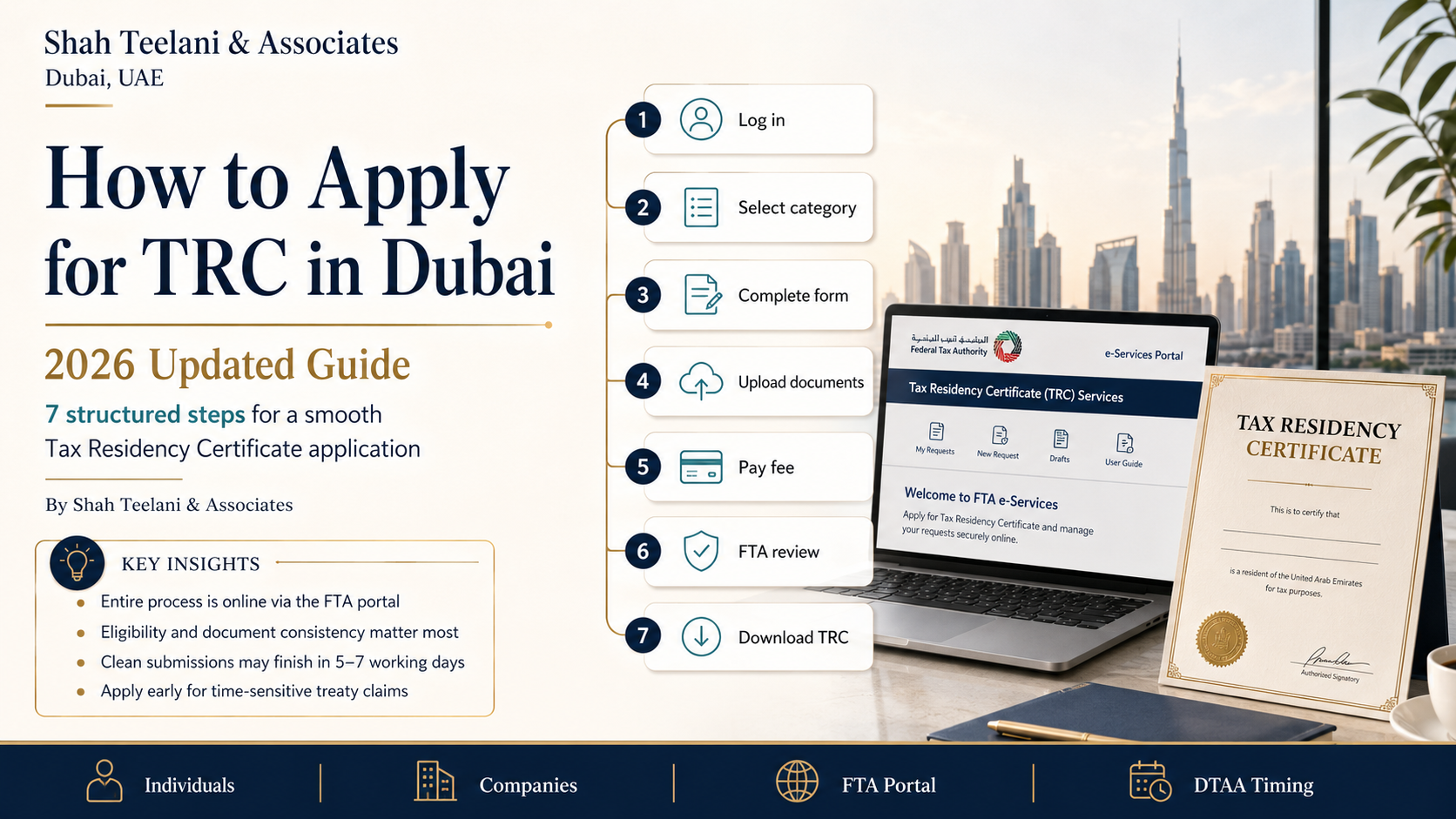
| Companies operating in the United Arab Emirates may require a Tax Residency Certificate (TRC) to formally establish their UAE tax residency for international compliance and treaty purposes. However, not every UAE-registered company automatically qualifies. The Federal Tax Authority evaluates corporate TRC applications against specific eligibility criteria designed to confirm that the company genuinely operates, is managed, and maintains substantive tax residency within the UAE. Understanding these criteria before applying is essential for any business engaged in cross-border transactions, international investment, or treaty-based tax planning. |
Introduction
As the UAE continues to strengthen its position as a global business hub and expands its network of bilateral tax treaties, the Corporate Tax Residency Certificate has become an increasingly important instrument for UAE-based companies engaged in international commerce. A corporate TRC, issued by the UAE Federal Tax Authority, provides formal confirmation that a company qualifies as a UAE tax resident — enabling it to access reduced withholding tax rates, invoke treaty-based exemptions, and establish a defensible cross-border tax position.
Yet the application process is not automatic. The Federal Tax Authority applies a structured eligibility framework under UAE Cabinet Decision No. 85 of 2022, evaluating whether a company demonstrates genuine UAE incorporation, substantive operational presence, effective local management, and ongoing regulatory compliance. A company that is registered in the UAE but lacks real commercial activity — or one whose management and control sit primarily outside the country — may not satisfy these criteria.
This guide provides a detailed explanation of the eligibility criteria for corporate TRC in Dubai and across the UAE: what each criterion requires, how it is assessed, which types of entities typically qualify, and what businesses should do to ensure they are TRC-ready before initiating an application.
The Legal Framework: UAE Cabinet Decision No. 85 of 2022
The eligibility criteria for corporate TRC applications are rooted in UAE Cabinet Decision No. 85 of 2022 on the Determination of Tax Residency. This regulation, which entered into force as part of the UAE’s transition to a formal corporate tax framework, defines when a juridical person — a company or other legal entity — is considered a UAE tax resident for international treaty purposes.
Under Cabinet Decision No. 85 of 2022, a juridical person is treated as a UAE tax resident if it is incorporated, formed, or recognised under UAE law. In addition, the Federal Tax Authority considers the concept of effective management — where key management and commercial decisions concerning the entity are substantively made — as a critical component of the residency determination.
This framework aligns with internationally accepted tax residency principles applied by OECD member states and reflects the UAE’s commitment to meeting global transparency and anti-abuse standards. For businesses, it means that a UAE registration certificate alone is not the complete answer: effective management and genuine operational substance within the UAE are equally important elements of a credible corporate tax residency claim.
Key Eligibility Criteria for Corporate TRC in Dubai
To obtain a Corporate Tax Residency Certificate in Dubai or any other Emirate, a company must generally satisfy all of the following conditions. Each criterion is examined by the Federal Tax Authority as part of its assessment of whether the entity has a genuine, substantive UAE tax residency position.
1. Legal Incorporation or Registration in the UAE
The most fundamental eligibility requirement is that the company must be legally established in the UAE. This encompasses a range of entity types, including:
- Mainland companies registered with UAE licensing authorities such as the Department of Economic Development
- Free zone companies incorporated within one of the UAE’s specialised economic zones
- Limited liability companies (LLCs), public and private joint stock companies (PJSCs), and similar structures
- Branches of foreign companies that are formally registered and licensed to operate in the UAE
The company must hold a valid trade licence issued by the relevant licensing authority, and that licence must be in force for the period to which the TRC application relates. A company that is incorporated abroad but has business interests in the UAE, without a formal UAE legal establishment, is not eligible to apply for a UAE corporate TRC.
2. Minimum Operational Period of One Year
The Federal Tax Authority generally requires that a company has been operational for at least one full year before a corporate TRC application can be submitted and approved. This requirement serves several important purposes:
- It ensures that the company has a genuine and established track record of business activity in the UAE, rather than being a newly incorporated entity with no commercial history
- It allows sufficient time for operational documentation — financial statements, bank records, contracts, and governance records — to be accumulated and made available for the application
- It reduces the risk of TRC applications by entities formed primarily to access treaty benefits without genuine commercial substance
Start-ups and recently incorporated entities should plan their TRC applications with this requirement in mind, ensuring that they have completed at least one full year of genuine operations — with contemporaneous records to evidence that activity — before initiating the application process.
3. Active Business Presence in the UAE
Legal registration is a necessary but insufficient condition for corporate TRC eligibility. The Federal Tax Authority also examines whether the company maintains genuine active business presence in the UAE — a requirement that goes beyond the existence of a registered address or nominal trade licence.
Indicators of active business presence that the FTA evaluates include:
- Physical office premises in the UAE that are genuinely occupied by the company’s staff and management — not merely a registered office address or a virtual office arrangement
- Commercially active operations generating revenue, serving clients, or conducting trade within or through the UAE
- UAE-based employees or management personnel who are substantively engaged in the company’s business activities
- Operational expenditure within the UAE, including salaries, rent, utilities, professional fees, and other business costs
- Active commercial contracts with clients, suppliers, or counterparties, whether domestic or international
The purpose of this criterion is to confirm that the company is not merely incorporated in the UAE on paper, but is genuinely conducting business from within the jurisdiction. Entities with minimal local presence — particularly those managed and controlled from abroad — will face significant challenges in satisfying this requirement.
4. Valid and Active Trade Licence
A valid UAE trade licence is a mandatory prerequisite for corporate TRC eligibility. The licence requirements are specific:
- The trade licence must be issued by a recognised UAE licensing authority — whether a mainland authority such as a Department of Economic Development, a free zone authority, or another relevant regulatory body
- The licence must cover the relevant financial year or period for which the TRC is being requested — a licence that was valid during a prior year but has since expired does not establish current eligibility
- The licence must reflect the company’s active business status — licences that have been suspended, cancelled, or placed under investigation may result in rejection
Companies should ensure that their trade licence is renewed promptly and that the licensed activity accurately reflects the nature of the business being conducted. Discrepancies between the licenced activity and the actual business operations can raise questions during the FTA review process.
5. Active Corporate Bank Account in the UAE
Companies applying for a corporate TRC are expected to maintain an active bank account with a UAE-licensed financial institution. This is not merely a procedural formality — bank account activity provides one of the most direct and objective indicators of genuine UAE economic presence.
The bank account evidence submitted with a TRC application typically serves to demonstrate:
- That the company conducts regular financial transactions within the UAE — including receiving client payments, paying suppliers and staff, and meeting local operating costs
- That the company’s primary financial activity is connected to its UAE business operations
- That the entity is commercially active and financially integrated within the UAE economy
A company applying for a corporate TRC should maintain an active banking relationship with a UAE-licensed financial institution. Regular financial transactions that reflect genuine commercial activity in the UAE strengthen the company’s overall tax residency profile and support the Federal Tax Authority’s assessment of operational substance.
6. Management and Control Exercised Within the UAE
One of the most substantively important eligibility criteria — and one that is increasingly scrutinised in the context of global transparency standards — is whether the company’s strategic management and key commercial decisions are made within the UAE.
This criterion aligns directly with the internationally recognised concept of the “place of effective management,” which is used by tax authorities worldwide to determine corporate tax residency. For UAE corporate TRC purposes, factors that support this criterion include:
- Board of directors meetings held physically in the UAE, with UAE-based attendance and contemporaneous minutes
- Senior management — including the CEO, CFO, and other C-suite executives — residing and operating from the UAE
- Key operational and strategic decisions — including budgeting, investment approvals, hiring, and contract execution — taken locally
- Corporate records, including board resolutions, shareholder registers, and constitutional documents, maintained within the UAE
Companies where management and control are effectively exercised from another country — even if the entity is legally incorporated in the UAE — may face challenges in demonstrating UAE corporate tax residency. Foreign tax authorities examining the company’s treaty claims will pay particular attention to this criterion.
7. Ongoing Regulatory Compliance
Companies must demonstrate ongoing compliance with UAE regulatory requirements as part of the TRC eligibility assessment. This includes:
- Maintaining valid corporate registrations across all relevant UAE authorities and regulatory bodies
- Filing required regulatory documentation — including annual returns, financial statements, and economic substance notifications where applicable
- Meeting applicable corporate governance standards under UAE company law and free zone regulations
- Complying with UAE Corporate Tax registration and filing obligations, where applicable, following the introduction of UAE Corporate Tax in June 2023
- Satisfying any applicable Economic Substance Regulations (ESR) requirements for companies conducting relevant activities in the UAE
Entities with unresolved compliance issues — including outstanding filings, unpaid fees, or regulatory investigations — may face delays, additional scrutiny, or outright rejection during the TRC application process. Ensuring full regulatory compliance before applying is therefore an important preparatory step.
Corporate TRC Eligibility Criteria at a Glance
The table below summarises the seven key eligibility criteria, the applicable thresholds or requirements, and the most important notes for each:
| Eligibility Criterion | Threshold / Requirement | Key Note |
|---|---|---|
| Legal Incorporation | Valid UAE registration — mainland, free zone, LLC, or branch | No registration = automatic ineligibility; trade licence must be current |
| Minimum Operational Period | Generally at least one full year of active operations | New shell entities or dormant companies will not qualify |
| Active Business Presence | Physical office, local employees, commercial contracts, operational expenditure | Mere registration without genuine activity is insufficient |
| Valid Trade Licence | Issued by a recognised UAE licensing authority; must cover the relevant financial year | Expired, suspended or cancelled licences result in rejection |
| Corporate Bank Account | Active UAE bank account with regular transactional history | Minimal or dormant accounts weaken the residency profile |
| Management & Control | Board meetings in UAE; senior management resident locally; key decisions taken in UAE | Aligns with the international ‘place of effective management’ standard |
| Regulatory Compliance | All corporate registrations current; governance standards met; no unresolved compliance issues | Outstanding regulatory issues can delay or block approval |
Types of UAE Companies That Typically Qualify for a Corporate TRC
A range of UAE entity types can qualify for a Corporate Tax Residency Certificate, provided they satisfy the eligibility conditions described above. The table below outlines the most common qualifying entity profiles and their TRC readiness considerations:
| Entity Type | Typical Profile | TRC Readiness Note |
|---|---|---|
| Mainland LLC / PJSC | Full commercial operations, UAE mainland trade licence, local employees | Strongest TRC profile — clear substance and regulatory footprint |
| Free Zone Company | Active operations within a UAE free zone, qualifying income generation | Must demonstrate genuine activity; free zone registration alone is not sufficient |
| Holding Company | Investment or asset management purpose with demonstrable local governance | Board meetings, management presence, and local accounting are critical |
| Branch of Foreign Company | UAE-registered branch conducting business through a local establishment | Branch must have genuine UAE operational presence independent of the parent |
| Professional Services Firm | Consulting, advisory or professional services delivered from UAE premises | Client contracts, fee records, and professional licences support the application |
Each entity type must independently satisfy the operational, governance, and documentation requirements. The legal form of incorporation alone — whether mainland, free zone, or branch — does not determine eligibility. What matters is whether the entity genuinely operates, is genuinely managed, and is genuinely compliant within the UAE.
The Critical Role of Economic Substance
In the current international tax environment, economic substance has become the central concept around which corporate tax residency credibility is assessed. UAE companies seeking a TRC — particularly those that intend to use it to access bilateral treaty benefits with countries such as India, the UK, or EU member states — must be able to demonstrate genuine substance within the UAE, not merely a legal registration.
The economic substance assessment examines:
- Whether the company’s core income-generating activities are conducted in the UAE by qualified staff with the authority to carry them out
- Whether the company has adequate physical assets, premises, and infrastructure to conduct its activities
- Whether the company’s management and decision-making are genuinely exercised within the UAE, as evidenced by board minutes, attendance records, and signed resolutions
- Whether the company’s financial accounts are prepared locally and accurately reflect its UAE operations
The UAE’s Economic Substance Regulations, introduced in 2019, require companies conducting certain relevant activities — including banking, insurance, investment fund management, intellectual property, holding company activities, and others — to meet specific substance requirements annually. Compliance with these ESR obligations is directly relevant to the credibility of a corporate TRC application.
| Key Principle:A corporate TRC is most defensible when it reflects what is already true in practice — a genuinely operating, genuinely managed, and genuinely compliant UAE business. Obtaining a TRC for a company that lacks substantive UAE presence creates significant audit exposure in treaty partner jurisdictions and may expose the company to anti-avoidance challenges. |
When a Company May Not Yet Qualify for a Corporate TRC
Even where a company is legally incorporated in the UAE, the Federal Tax Authority may decline or delay issuing a Tax Residency Certificate if the entity does not sufficiently demonstrate genuine operational presence or regulatory compliance. Situations such as newly established companies with limited operational history, inactive business structures, or companies whose management decisions are primarily taken outside the UAE may require further clarification before a TRC can be issued.
A detailed discussion of the most common reasons for TRC rejection and how companies can address them is provided later in this guide.
Preparing for Corporate TRC Eligibility: A Practical Checklist
Companies planning to apply for a Corporate Tax Residency Certificate in Dubai should conduct a thorough readiness review before submitting their application. The following checklist covers the key preparation steps:
Trade Licence and Corporate Registrations
- Confirm that the UAE trade licence is valid, current, and covers the relevant financial year
- Verify that all corporate registrations — with free zone authorities, mainland licensing bodies, and other relevant regulators — are up to date
- Ensure that the licensed activity accurately reflects the actual business operations
Operational Substance Documentation
- Confirm that the company has physical office premises that are genuinely occupied and operational
- Ensure that UAE-based staff records, employment contracts, and payroll records are current and accurately maintained
- Compile a list of active commercial contracts demonstrating the company’s business activity
- Prepare a summary of UAE operational expenditure during the relevant period
Governance and Management Records
- Ensure that board meeting minutes for the relevant period are properly recorded, signed, and reflect decisions taken within the UAE
- Confirm that board resolutions, shareholder registers, and constitutional documents are current and correctly maintained
- Verify that senior management attendance at UAE-based meetings is documented and can be evidenced by travel and accommodation records
Financial Records and Banking
- Ensure that financial records and banking activity accurately reflect the company’s UAE operations and are properly maintained for regulatory and tax compliance purposes.
- Ensure that audited or management financial statements for the relevant year are prepared, complete, and accurately reflect the company’s UAE operations
- Confirm that UAE Corporate Tax registration is current and that all filing obligations are met
Regulatory Compliance Review
- Verify that Economic Substance Regulations notifications and reports have been submitted where required
- Confirm that there are no outstanding regulatory issues, unpaid government fees, or unresolved compliance matters that could delay the TRC application
A thorough pre-application review significantly reduces the risk of rejection, minimises processing delays, and ensures that the corporate TRC is issued on a sound and defensible evidentiary basis.
Practical Scenarios Illustrating Corporate TRC Eligibility
Scenario 1: The Active UAE Trading Company
A mainland LLC registered in Dubai has been operating for three years, employs a team of ten UAE-based staff, leases a commercial office, maintains active client contracts in the Gulf region, and holds a current trade licence. Its board meets quarterly in Dubai, and its financial statements are audited by a UAE-registered firm. This company presents a strong and well-evidenced corporate TRC application profile.
Scenario 2: The Free Zone Holding Company
A free zone company incorporated in Dubai holds equity stakes in subsidiaries across South Asia and Europe. It has a registered free zone office, two UAE-resident directors, and maintains UAE corporate bank accounts with regular dividend receipts and distributions. Board meetings are held in the UAE with documented minutes. Provided it satisfies the applicable Economic Substance Regulations for holding company activities, this entity has a defensible TRC profile — though it should be prepared to address substance questions from treaty partner jurisdictions.
Scenario 3: The Newly Incorporated Entity
A UAE free zone company was incorporated six months ago as an international consultancy vehicle. It has a registered address, a trade licence, and a UAE bank account, but has conducted minimal business activity to date and has not yet held formal board meetings in the UAE. This company does not yet satisfy the minimum operational period requirement and would likely face rejection if a TRC application were submitted at this stage. It should focus on building a genuine operational record before applying.
Conclusion
Obtaining a Corporate Tax Residency Certificate in Dubai requires companies to satisfy a structured set of eligibility criteria that go well beyond simple legal registration. Genuine UAE incorporation, substantive active operations, management and control exercised locally, a valid trade licence, active UAE banking, and full regulatory compliance are all essential components of a credible and approvable corporate TRC application.
In the context of UAE Corporate Tax and heightened international scrutiny of cross-border structures, the standards for what constitutes genuine corporate tax residency have never been higher. Companies that invest in building real substance — offices, staff, governance, and financial records — are not only better positioned to obtain a TRC but are also building a more defensible and durable cross-border tax position overall.
Understanding these eligibility requirements in advance, conducting a thorough pre-application review, and ensuring that all documentation is contemporaneous, complete, and consistent are the foundations of a successful corporate TRC application and a robust UAE tax residency framework.
