


| Obtaining a Tax Residency Certificate (TRC) in the UAE is an important step for individuals who need official confirmation of their UAE tax residency for international tax compliance purposes. However, the certificate is not automatically issued to every UAE resident. The UAE Federal Tax Authority has established specific eligibility requirements based on physical presence, legal residency status, and supporting documentation. Understanding these requirements before applying is essential to avoid rejection and ensure a smooth process. |
Introduction
As the UAE continues to grow as a global hub for business, investment, and long-term residency, the Tax Residency Certificate has become one of the most important compliance documents available to individuals living in Dubai and across the Emirates. It serves as formal, government-issued confirmation that an individual qualifies as a UAE tax resident — a document that foreign tax authorities, financial institutions, and international counterparties increasingly require before applying treaty benefits or updating residency classifications.
Yet a common misconception is that simply holding a UAE residence visa or Emirates ID is sufficient to obtain a TRC. In practice, the UAE Federal Tax Authority (FTA) applies a structured eligibility framework grounded in UAE Cabinet Decision No. 85 of 2022, which sets out the objective criteria an individual must satisfy before a certificate can be issued.
This guide provides a comprehensive explanation of those eligibility criteria: what each requirement means, how it is assessed, which categories of individuals typically qualify, and what steps applicants should take to ensure their residency position is fully documented and defensible before submitting an application.
The Legal Framework: UAE Cabinet Decision No. 85 of 2022
The eligibility criteria for individual TRC applications in the UAE are governed primarily by Cabinet Decision No. 85 of 2022 on the Determination of Tax Residency. This regulation, introduced as part of the UAE’s alignment with global tax standards, provides a clear and objective framework for determining when a natural person qualifies as a UAE tax resident.
Prior to this legislation, the UAE lacked a codified domestic tax residency definition for individuals. Cabinet Decision No. 85 changed that, introducing two distinct residency pathways — the primary 183-day rule and the alternative 90-day rule — alongside a set of supporting conditions related to personal and economic ties.
Understanding this legal framework is the starting point for any individual considering a TRC application. Meeting the formal residency thresholds under Cabinet Decision No. 85 is a prerequisite for eligibility — and a TRC issued by the FTA constitutes formal confirmation that those thresholds have been met.
Primary Eligibility Criteria for TRC in UAE (Individuals)
To apply for a Tax Residency Certificate in Dubai or any other Emirate, an individual must satisfy a combination of the following core conditions. Meeting only one criterion in isolation is typically insufficient — the FTA looks for a coherent, evidence-based picture of genuine UAE tax residency.
1. Minimum Physical Presence in the UAE
Physical presence is the most fundamental eligibility criterion for individual TRC applications. Under the primary rule established by Cabinet Decision No. 85 of 2022, an individual must have been physically present in the UAE for at least 183 days during any consecutive 12-month period.
This 183-day threshold reflects the internationally recognised standard for establishing tax residency through physical presence and is used by tax authorities worldwide as a primary residency indicator. For the purpose of TRC applications, the FTA assesses presence over the 12-month period relevant to the certificate being sought.
Key points to understand regarding the physical presence requirement:
- Days of arrival and departure are generally counted as days of UAE presence
- Short business trips or holidays abroad during an otherwise UAE-based lifestyle do not typically break continuity, provided total presence still meets the threshold
- Individuals who spend the majority of their time in another country while maintaining a UAE visa will generally not satisfy this requirement
- Presence must be documented — relying on memory or informal records is insufficient; passport entry and exit stamps, airline records, and hotel or accommodation receipts provide useful supporting evidence
For individuals whose work or personal commitments require frequent international travel, the 183-day rule may be challenging to satisfy. The alternative 90-day pathway, discussed below, may be more appropriate in such cases.
2. Valid UAE Residence Visa
An individual must hold a valid UAE residence visa issued by the relevant immigration authority at the time of application. A UAE residence visa is legally distinct from a tourist visa, visit visa, or transit permit — and holders of these non-residency statuses are not eligible to apply for a TRC.
The residence visa categories that typically support TRC eligibility include:
- Employment residence visa — sponsored by a UAE-based employer
- Investor or partner visa — held by business owners and company shareholders
- Freelance visa — issued to self-employed professionals and independent contractors
- Golden Visa — the UAE’s long-term residency visa available to investors, entrepreneurs, skilled professionals, and exceptional talents
- Dependent or family visa — for spouses and dependants of UAE residents, subject to meeting other eligibility conditions
A valid Emirates ID — the national identity card issued to all UAE residents — is also typically required as part of the TRC application. Both the visa and the Emirates ID must be current and valid throughout the relevant residency period.
3. Evidence of Residential Presence: A Physical Address in the UAE
Beyond holding a visa, individuals must demonstrate that they actually live in the UAE — not merely that they are legally permitted to do so. The FTA assesses whether the applicant maintains genuine residential ties to the country, rather than treating the UAE as a convenience address while residing primarily elsewhere.
Applicants must demonstrate genuine residential presence in the UAE through appropriate supporting documentation, which typically includes proof of accommodation and residency records.
The address provided must reflect genuine occupation. A hotel address, a company’s registered office address, or an address belonging to a family member without evidence of the applicant’s own occupation will generally not satisfy this requirement.
4. Active UAE Bank Account
Individuals applying for a TRC are typically expected to maintain an active bank account with a UAE-licensed financial institution. While this is not a standalone statutory requirement in the same manner as physical presence or visa status, it forms an important part of the supporting documentation that demonstrates genuine economic integration with the UAE.
The bank account evidence serves to show:
- That the individual conducts day-to-day financial transactions within the UAE
- That salary, business income, or investment proceeds are received or managed through a UAE account
- That the individual’s economic footprint is genuinely anchored in the UAE during the relevant period
Bank statements covering the relevant 12-month period are typically submitted as part of the TRC application package. Accounts with minimal or no transactional activity may weaken the overall residency profile even where other criteria are met.
5. Personal and Economic Ties to the UAE
The final core criterion is the demonstration of meaningful personal and economic connections to the UAE. While this does not always appear as a separate formal requirement in FTA guidance, it materially strengthens the residency assessment and can be decisive in borderline cases.
Indicators that evidence genuine personal and economic ties include:
- Employment with a UAE-based company or institution
- Active ownership or management of a business registered in the UAE
- Family residence in the UAE — particularly if a spouse and children are also UAE residents
- Enrolment of children in UAE schools
- Membership in UAE professional associations, clubs, or community organisations
- Healthcare and insurance arrangements held in the UAE
Taken together, these ties help establish that the individual’s centre of vital interests — the place where their most significant personal and economic relationships are located — is the UAE. This concept is important not only for FTA assessment but also for treaty tie-breaker analysis if dual residency is asserted by a foreign tax authority.
The Alternative 90-Day Residency Rule
Cabinet Decision No. 85 of 2022 introduced an alternative residency pathway for individuals who may not satisfy the 183-day threshold but who nonetheless maintain a clear and substantive connection to the UAE. Under this alternative rule, an individual may qualify as a UAE tax resident if they meet all of the following conditions simultaneously:
- They have been physically present in the UAE for at least 90 days during any consecutive 12-month period
- They are a UAE national, GCC national, or hold a valid UAE residence permit
- They maintain a permanent place of residence in the UAE — meaning a home that is continuously available to them, not merely a hotel stay or temporary accommodation
- They conduct employment or business activity in the UAE during the relevant period
This alternative pathway is particularly relevant for:
- UAE and GCC nationals who divide their time between the UAE and other GCC countries
- Business owners and executives whose professional responsibilities require significant international travel but whose primary home and business are in the UAE
- Professionals transitioning to UAE residency who have not yet accumulated 183 days but who have established a clear, substantive UAE base
It is important to note that the 90-day rule is not a lower-threshold alternative available to everyone — it carries additional conditions that must all be satisfied concurrently. An individual who is simply present in the UAE for 90 days without the other qualifying factors will not meet this criterion.
Eligibility Criteria at a Glance
The table below summarises the primary eligibility criteria and key notes for individual TRC applications in the UAE:
| Eligibility Criterion | Threshold / Requirement | Key Note |
|---|---|---|
| 183-day rule | Resident 183+ days in any 12-month period | Core test — applies to most applicants |
| 90-day alternative | 90+ days in the UAE + UAE/GCC national or resident with permanent home or activity | Flexibility for frequent travellers with clear UAE base |
| Valid residency visa | Employment, investor, freelance, golden or partner visa | Tourist or visit visa holders do not qualify |
| Physical address | Tenancy contract, registered lease, or owned property | Must reflect genuine occupation, not a convenience address |
| Bank activity | Active UAE bank account with transactional history | Demonstrates day-to-day economic integration |
| Personal/economic ties | Employment, business ownership, family residence | Strengthens the overall residency profile |
Who Typically Qualifies for a TRC in the UAE?
The following categories of individuals most commonly satisfy the eligibility criteria and successfully obtain a UAE Tax Residency Certificate:
Expatriate Professionals in Full-Time Employment
Employees working for UAE-based companies who live in the country for the majority of the year represent the most straightforward TRC applicant profile. They typically hold employment visas, maintain residential leases, have active UAE bank accounts, and accumulate well over 183 days of presence annually. Their residency documentation is usually comprehensive and consistent.
Entrepreneurs and Business Owners
Individuals holding investor or partner visas who actively manage businesses in the UAE commonly qualify for a TRC, provided they maintain genuine day-to-day presence in the country. Their business ownership, commercial contracts, and UAE-based banking activity typically provide strong supporting documentation. However, business owners who manage UAE entities remotely from abroad without regular UAE presence may face eligibility challenges.
High-Net-Worth Individuals and Global Investors
HNIs who establish UAE tax residency as part of cross-border wealth planning — including portfolio management, real estate investment, and family office structuring — can qualify provided they accumulate sufficient UAE presence and maintain documented residential and economic ties. For this category, careful day-counting and proactive documentation management are particularly important, as the residency position may be subject to scrutiny from home-country tax authorities.
Remote Professionals and Digital Nomads
Individuals living in Dubai while earning income from overseas employers or international consulting clients are an increasingly common applicant profile. They can qualify for a TRC provided they meet the physical presence threshold, hold an appropriate visa (such as a freelance visa or remote work visa), maintain a UAE residential address, and have active UAE banking arrangements. The source of their income being overseas does not disqualify them from UAE residency.
Golden Visa Holders
Holders of the UAE’s Golden Visa — a long-term residency visa valid for five or ten years — may qualify for a TRC subject to satisfying the same physical presence and documentation requirements as other residency visa holders. The Golden Visa itself does not grant automatic TRC eligibility; the underlying presence and tie conditions must still be met independently.
Situations Where Individuals May Not Qualify
Understanding the disqualifying circumstances is as important as understanding the qualifying ones. The FTA may reject a TRC application or request significant additional documentation in the following situations:
- Physical presence below the required threshold — spending the majority of the year outside the UAE while maintaining a UAE visa is one of the most common reasons for application failure
- Holding only a tourist visa, visit visa, or transit permit — these do not constitute legal residency for TRC purposes
- Primary residence clearly established in another country — for example, maintaining a family home, children’s schooling, and primary banking in a foreign jurisdiction
- Absence of a documented UAE residential address — relying on a company address, hotel, or a relative’s accommodation without evidence of personal occupation
- No active UAE bank account or demonstrably minimal UAE financial activity during the relevant period
- Insufficient documentation overall — even where factual presence is genuine, failure to maintain and produce contemporaneous records is a common cause of application delays and rejections
| Important Note:A TRC application that is submitted prematurely — before the eligibility criteria are genuinely met — risks rejection, additional fees, and potential scrutiny of the underlying residency claim. It is always preferable to wait until the criteria are satisfied and the documentation is complete before applying. |
Planning Ahead for TRC Eligibility
For individuals who intend to obtain a Tax Residency Certificate, proactive planning significantly improves the likelihood of a smooth and successful application. The key steps to take before applying include:
Track and Document Physical Presence
Maintain a contemporaneous record of all UAE entry and exit dates. Passport stamps provide the primary evidence, but supplementary records — including airline booking confirmations, hotel receipts, and boarding passes — can provide additional support. For individuals whose work involves regular travel, a dedicated travel log is a practical and valuable precaution.
Maintain Up-to-Date Residential Documentation
Ensure that your tenancy contract or property ownership documents are current, registered with the relevant authority, and in your name. Renew lease agreements promptly and retain copies of all signed documentation. A gap in residential documentation during the relevant period can create complications even where physical presence is genuine.
Keep UAE Banking Records Active and Accessible
Ensure your UAE bank account reflects regular transactional activity throughout the relevant period — not just at the time of application. Salary credits, utility payments, regular purchases, and investment transactions all contribute to a credible economic presence record. Request and retain periodic bank statements well in advance of any planned TRC application.
Ensure Visa and Emirates ID Validity
Confirm that your UAE residence visa and Emirates ID remain valid throughout the 12-month period to which the TRC application relates. A period of visa lapse or Emirates ID expiry during the relevant year can create gaps in your legal residency status that complicate the application. Renew both documents promptly and proactively.
Consider Broader Tax Residency Positioning
For individuals with ongoing tax residency ties to a former home country — particularly if that country applies exit taxes, statutory residency tests, or deemed residency rules — UAE TRC planning should be coordinated with a broader review of global tax residency positioning. A UAE TRC is most effective when it forms part of a coherent, well-documented overall residency structure rather than being obtained in isolation.
What Happens After Eligibility Is Confirmed?
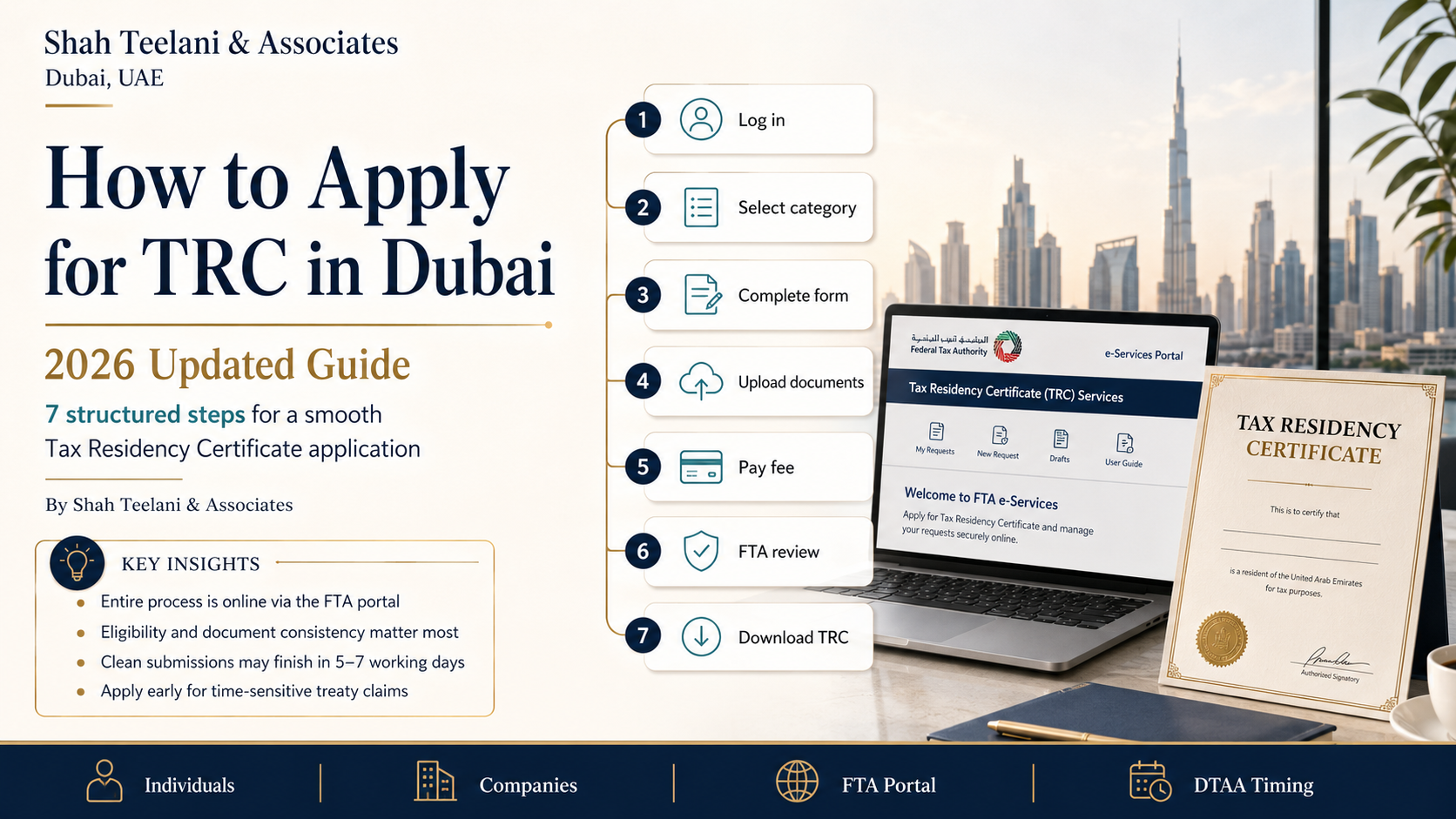
Once an individual is satisfied that they meet the eligibility criteria, the next step is preparing the complete documentation package and submitting the application through the UAE Federal Tax Authority’s online portal. The TRC application process involves:
- Compiling and uploading all required supporting documents, including passport, Emirates ID, visa copy, tenancy contract, bank statements, and presence evidence
- Completing the FTA’s online application form and specifying the relevant financial year or 12-month period for which the certificate is sought
- Paying the applicable government fee, which varies depending on the applicant category and the intended use of the certificate
- Awaiting FTA review and, if approved, receiving the digitally issued TRC
Processing timelines can vary. Applications with complete, well-organised documentation are typically processed more quickly than those requiring follow-up queries or additional submissions. Ensuring eligibility and documentation completeness before submitting is the single most effective way to minimise processing time.
Conclusion
Qualifying for a Tax Residency Certificate in the UAE as an individual requires more than simply living in Dubai or holding a UAE residence visa. Applicants must satisfy a structured set of eligibility conditions — centred on physical presence, legal residency status, a genuine residential address, active economic integration, and meaningful personal ties — as established under UAE Cabinet Decision No. 85 of 2022.
Meeting these criteria confirms that the individual genuinely qualifies as a UAE tax resident under applicable law and international standards. A TRC obtained on this basis provides formal, defensible confirmation of UAE residency that can be relied upon in treaty claims, withholding tax applications, and residency status disclosures to foreign tax authorities and financial institutions.
Understanding and satisfying the eligibility requirements in advance — and maintaining the documentation to evidence them — is the foundation of an effective UAE tax residency strategy.
