


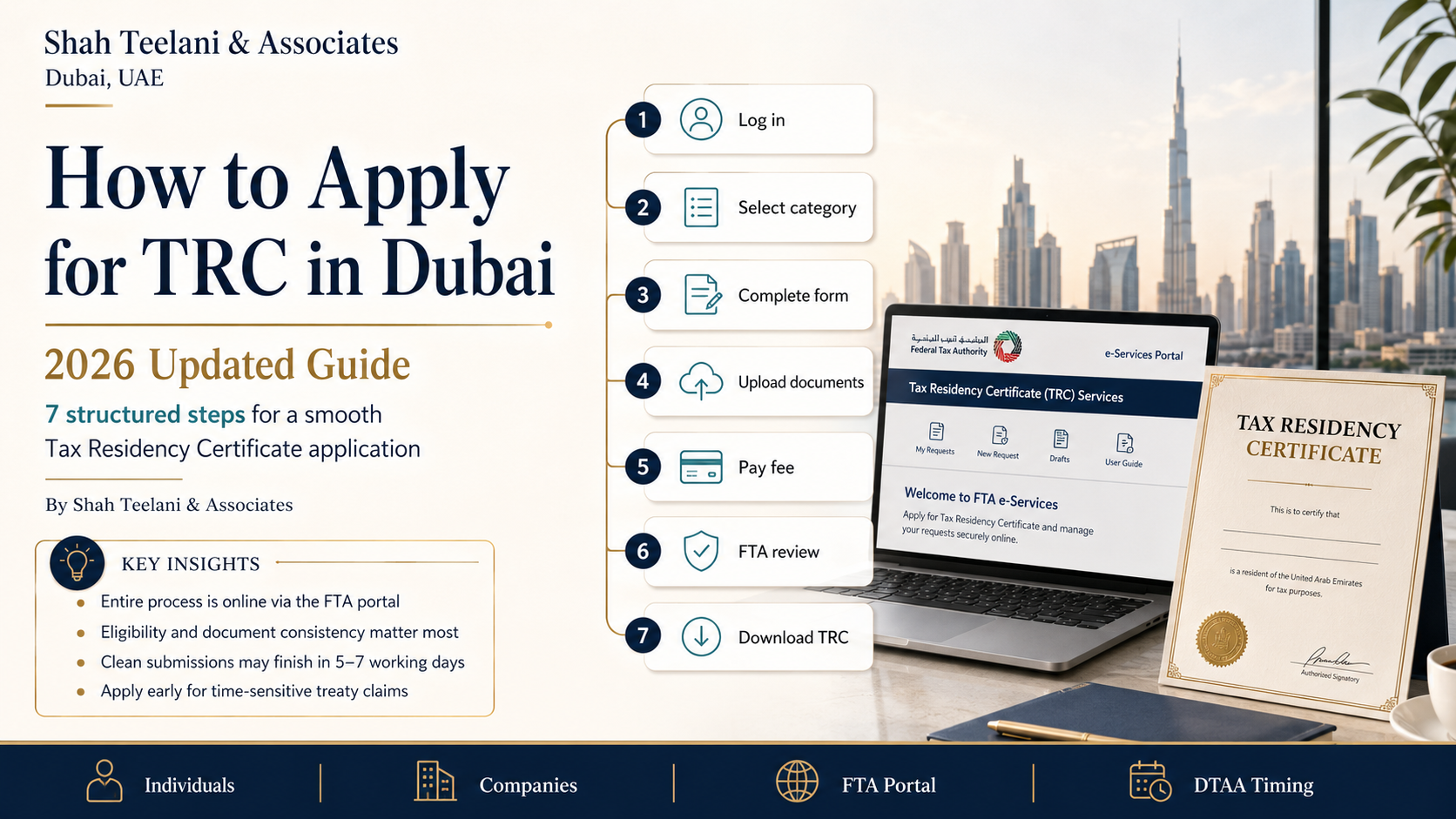
| A Tax Residency Certificate (TRC) issued in Dubai serves one core function — confirming UAE tax residence for a defined period. However, the implications, compliance approach, documentation profile, and strategic usage differ significantly depending on whether the applicant is an individual or a corporate entity. Understanding these distinctions is essential for anyone structuring cross-border tax positions from a Dubai base. |
Introduction
As the UAE continues to attract internationally mobile professionals, entrepreneurs, investors, and multinational businesses, the Tax Residency Certificate has become one of the most sought-after compliance documents issued by the UAE Federal Tax Authority. For individuals relocating to Dubai, it confirms personal tax residence. For companies incorporated or managed in the UAE, it confirms corporate tax residence.
Yet one of the most common sources of confusion in cross-border tax planning is the assumption that these two certificates are interchangeable — or that obtaining one automatically covers the other. They are legally distinct instruments, evaluated under different criteria, supported by different documentation, and serving different strategic purposes.
This guide provides a comprehensive, structured comparison of individual TRC and corporate TRC in Dubai: what each requires, how each is used, where the risks lie, and how to determine which type — or combination of types — your situation demands.
Understanding the Core Distinction
At the foundational level, the difference is straightforward:
- An Individual TRC confirms that a natural person — an employee, consultant, investor, or entrepreneur — qualifies as a UAE tax resident for a specific period.
- A Corporate TRC confirms that a legal entity — a company, partnership, or other business structure incorporated or effectively managed in the UAE — qualifies as a UAE tax resident.
While the certificate format may appear similar on the surface, the residency determination criteria, compliance expectations, documentation requirements, and global implications differ materially. A person who holds a corporate TRC for their UAE company does not automatically hold individual UAE tax residency — and vice versa. The two must be assessed and obtained independently.
TRC for Individuals in Dubai
For individuals, the UAE tax residency determination centres on personal presence, lifestyle, and economic ties to the UAE. The focus is on where the individual genuinely lives and manages their personal affairs — not merely where their income originates.
1. Residency Basis: Physical Presence and Personal Ties
Individual TRC eligibility is largely based on physical presence and personal economic ties to the UAE. The detailed residency tests and qualifying thresholds are covered separately in our guide on TRC eligibility criteria. – [add link of next blog]
2. Income Profile: When Individuals Seek a TRC
Individuals typically apply for a TRC when they have cross-border income or asset exposure that requires formal residency documentation. Common situations include:
- Foreign investment income — dividends, interest, or capital gains from overseas portfolios
- Consulting, advisory, or employment income from international clients or employers
- Capital gains exposure from the sale of overseas assets, including shares, real estate, or business interests
- Cross-border asset holdings requiring treaty-based residency confirmation
- Family office and wealth management structures with multi-jurisdiction income flows
The individual TRC supports the person’s overall tax residency profile across all these income streams, rather than being tied to a single transaction or payer relationship.
3. Substance Evaluation for Individuals
When a foreign tax authority or financial institution scrutinises an individual’s UAE residency claim, the substance evaluation focuses on personal and lifestyle-based evidence — covering physical presence, residential ties, financial footprint, and family relocation status. Authorities look for a coherent, consistent picture of genuine relocation, not merely the existence of a UAE visa or bank account. The specific eligibility thresholds and qualifying criteria that underpin this assessment are covered in detail in our guide on TRC eligibility criteria for individuals and corporates. [add link of next blog]
4. Risk Areas Unique to Individual TRC
Several compliance risks are specific to individual applicants:
- Dual residency: Remaining tax resident in a former home country under that country’s domestic rules while also holding UAE residency creates dual-residency exposure, requiring careful treaty tie-breaker analysis
- Exit tax triggers: Several European countries and other jurisdictions impose exit taxes on unrealised capital gains when individuals cease domestic tax residency
- Citizenship-based taxation: US citizens and green card holders remain subject to US federal tax obligations regardless of UAE residency status
- Habitual abode and centre-of-vital-interests tests: European jurisdictions in particular apply these extended residency criteria, which may conflict with UAE residency claims
- Split-year residency transitions: The year of departure from a home country and the year of arrival in the UAE often require careful, coordinated management
TRC for Companies in Dubai
Corporate TRC operates under a fundamentally different analytical framework. For companies, tax residency is not determined by where employees or shareholders live — it is determined by where the company itself is incorporated and, critically, where effective management and control are exercised.
1. Residency Basis: Incorporation and Effective Management
Corporate TRC eligibility depends on factors such as incorporation in the UAE and the location of effective management. These criteria determine whether a company qualifies as a UAE tax resident.
2. Operational Substance Requirements
Corporate TRC applicants must demonstrate that the entity has genuine operational substance in the UAE. Following the introduction of UAE Corporate Tax in June 2023, this requirement has become more formally significant — spanning active business operations, physical presence, local governance, and financial record-keeping. For entities operating within UAE free zones, additional considerations apply, particularly in relation to qualifying income thresholds and the interaction between free zone tax regimes and UAE Corporate Tax Law. The specific eligibility criteria and substance thresholds applicable to both mainland and free zone entities are examined in detail in our guide on TRC eligibility criteria for individuals and corporates. [add link of next blog]
3. Income Profile: When Companies Seek a TRC
Companies typically require a TRC in contexts involving recurring commercial flows across borders, rather than portfolio or investment income. Common scenarios include:
- Cross-border service contracts where the UAE entity invoices international clients
- International trading structures where goods or commodities are sourced and sold across multiple jurisdictions
- Intellectual property holding companies licensing technology, software, or brand rights into foreign markets
- Financing arrangements where the UAE entity lends to or receives loans from related or third-party entities
- Holding company structures managing equity stakes in subsidiaries across multiple countries
- Intercompany transactions within multinational groups requiring treaty-rate withholding tax treatment
4. Governance and Documentation Expectations
Corporate TRC applications involve a more extensive governance and documentation review than individual applications. Authorities may examine:
- Trade licence validity and scope of licensed activity
- Memorandum and Articles of Association
- Board resolutions demonstrating that key decisions are made in the UAE
- Audited or management financial statements
- Shareholding structure and beneficial ownership transparency
- Evidence of management control — including meeting minutes, director attendance, and signed authorities
For entities with multinational ownership structures, authorities may also evaluate beneficial ownership chains to ensure that treaty claims are not being routed through UAE entities without genuine commercial purpose.
Key Structural Differences at a Glance
The table below summarises the principal differences between individual and corporate TRC in Dubai:
| Aspect | Individual TRC | Corporate TRC |
|---|---|---|
| Residency Test | Physical presence & personal ties | Incorporation & effective management |
| Substance Type | Lifestyle & economic presence | Operational & commercial activity |
| Key Risk Factors | Dual residency, exit tax, citizenship tax | Permanent establishment risk abroad |
| Income Type | Investment & personal income | Business & intercompany income |
| Compliance Focus | Personal reporting & lifestyle alignment | Governance, structure & substance |
| Renewal Trigger | Visa status, days in UAE, family ties | Trade licence, activity & management continuity |
| Scrutiny Focus | Genuine relocation evidence | Economic substance & management control |
Renewal and Continuity Considerations
Both individuals and companies must renew their TRC annually if continued treaty access or ongoing residency documentation is required. However, the events that trigger renewal complications differ significantly between the two.
Renewal Triggers for Individuals
An individual’s TRC renewal may be affected by:
- Change in UAE visa status — including visa cancellation, change of sponsor, or transition between visa categories
- Reduced days of physical presence in the UAE, falling below the qualifying threshold
- Relocation of family members back to a home country, weakening the centre-of-vital-interests argument
- Change in primary residence — for example, purchasing or renting a property in another country
- Extended business travel abroad that materially reduces UAE presence during the relevant period
Renewal Triggers for Companies
A corporate TRC renewal may be complicated by:
- Trade licence lapse or non-renewal, which undermines the legal basis for UAE corporate presence
- Dormant or inactive business status — an entity with no commercial activity may struggle to demonstrate operational substance
- Shift in management control — where key decision-making moves outside the UAE
- Business restructuring, mergers, or demergers that alter the entity’s corporate structure
- Changes in directors or shareholders that affect the governance profile of the entity
Corporate restructuring events in particular require careful coordination with TRC renewal timelines. A gap in TRC coverage during a restructuring period can create treaty access issues for transactions occurring in the interim.
Audit and International Scrutiny
In an era of unprecedented international tax transparency, both individual and corporate TRC holders face the possibility of scrutiny from foreign tax authorities. The nature of that scrutiny, however, differs between the two.
For Individuals
Foreign tax authorities — particularly in the UK, EU member states, and India — may examine whether an individual has genuinely relocated or is maintaining a UAE address of convenience. Areas of focus include:
- Whether the individual’s lifestyle, family, and economic activity genuinely centres in the UAE
- Whether CRS reporting from UAE financial institutions is consistent with the residency claim
- Whether the individual satisfies the home country’s departure criteria under its domestic residence test
For Companies
Foreign tax authorities scrutinising corporate structures typically focus on:
- Whether the company genuinely operates from Dubai or is a shell with no substantive local activity
- Whether management and control are actually exercised within the UAE or remain with shareholders abroad
- Whether the company satisfies economic substance regulations applicable in the UAE
- Whether the structure reflects genuine commercial logic or is principally motivated by treaty access
In both cases, a TRC is a necessary but not sufficient condition for a sustainable residency position. It documents the formal claim — but the factual record must independently support it.
A Critical Misconception: Company TRC Does Not Cover the Individual
One of the most frequently encountered misconceptions in cross-border tax planning is the assumption by founders and entrepreneurs that:
| Common Misconception:“My UAE company has a TRC, so I am personally covered as a UAE tax resident.”This is incorrect. A corporate TRC confirms the residency of the legal entity — not the personal tax residency of its shareholders, directors, or beneficial owners. An individual’s personal tax residency must be evaluated and documented separately, entirely on its own merits. |
The reverse is equally true: an individual TRC does not automatically confirm the corporate residency of a company that the individual owns or controls. Each must stand independently on the evidence applicable to it.
In practice, a founder with a UAE holding company may need to obtain both:
- An individual TRC — to establish and document personal UAE tax residency
- A corporate TRC — to establish and document the company’s UAE corporate tax residency
These two certificates interact and complement each other in a well-structured cross-border arrangement — but neither substitutes for the other.
Impact of the UAE Corporate Tax Environment
The introduction of UAE Corporate Tax — effective for financial years beginning on or after 1 June 2023 — has added a new dimension to corporate TRC considerations. Companies must now ensure that:
- Their TRC status is consistent with their UAE Corporate Tax registration and filing obligations
- Financial records reflect genuine, active operations that support both corporate tax compliance and TRC documentation
- Evidence of management control and decision-making in the UAE is contemporaneously maintained, not reconstructed retrospectively
- Free zone entities assess whether they qualify for the 0% qualifying income rate and how this interacts with treaty claims supported by a TRC
For individuals, the introduction of UAE Corporate Tax does not generally affect personal TRC status — unless the individual is a sole proprietor operating through a UAE entity that is now within the corporate tax regime. In such cases, the personal and corporate dimensions of residency planning become more closely intertwined.
Practical Scenarios Illustrating the Difference
Scenario 1: The Relocating Consultant
An individual consultant earning advisory income from international clients relocates to Dubai and establishes personal UAE residency. She requires an individual TRC to support her personal tax residency position with foreign clients who apply source-country withholding tax. A corporate TRC for a company she may own is separate and would require independent documentation.
Scenario 2: The UAE Trading Company
A UAE-registered trading company with active contracts across multiple countries requires a corporate TRC to support treaty-rate withholding tax treatment on cross-border payments. The TRC documents the company’s UAE corporate tax residency. Whether the shareholders or directors are personally UAE tax resident is a separate question requiring separate documentation.
Scenario 3: The Founder with a UAE Holding Structure
A founder has relocated to Dubai and established a UAE holding company that owns equity stakes in businesses across multiple countries. In this case, the founder may require:
- An individual TRC — to document personal UAE tax residency and support personal treaty claims on dividend income, capital gains, and consulting fees
- A corporate TRC for the holding company — to support the entity’s treaty applications and withholding tax treatment on dividends received from subsidiaries
Each certificate must be obtained, maintained, and renewed independently. The strength of each depends on the evidence supporting it — personal substance for the individual, operational substance for the company.
Choosing the Correct TRC Type for Your Situation
Determining which type of TRC — or combination of types — is appropriate depends on a careful assessment of your specific circumstances. The key variables include:
- Ownership and governance structure: Who owns the entity, where are decisions made, and how is income flowing between individual and corporate layers?
- Income type: Is the income personal in nature (investment returns, consulting fees, employment income) or commercial in nature (service contracts, intercompany flows, trading income)?
- Cross-border exposure: Which jurisdictions are involved, and what do their domestic rules and applicable treaties require in terms of residency documentation?
- Family and lifestyle circumstances: Has the individual genuinely relocated, and does the overall factual picture support a UAE residency claim?
- Long-term business and succession strategy: Is the TRC intended to support a short-term transaction or a long-term structural position?
For complex structures involving both individual and corporate layers — such as founder-led businesses, family offices, or multi-entity holding arrangements — a coordinated approach to TRC planning across both dimensions is strongly advisable.
Strategic TRC Positioning: Individuals vs Companies
Individual TRC Strategy
For individuals, effective TRC strategy typically focuses on:
- Establishing and maintaining a genuine lifestyle-based presence in the UAE that satisfies both UAE requirements and foreign scrutiny
- Managing investment income, capital gains, and personal consulting income in a manner that is consistent with the UAE residency position
- Avoiding dual residency through coordinated management of departure from the home country and arrival in the UAE
- Aligning personal wealth planning — including pension interests, insurance arrangements, and estate planning — with the UAE residency framework
Corporate TRC Strategy
For companies, effective TRC strategy centres on:
- Building and maintaining demonstrable operational substance in Dubai, including staff, office, contracts, and local decision-making
- Ensuring corporate governance records — board minutes, resolutions, and management accounts — consistently reflect UAE-based control
- Aligning the corporate TRC with UAE Corporate Tax registration and compliance obligations
- Coordinating TRC renewal with trade licence renewal and any planned corporate restructuring events
- Managing the interaction between free zone benefits, corporate tax qualifying income rules, and treaty access
Conclusion
While both individuals and companies in Dubai can obtain a Tax Residency Certificate from the UAE Federal Tax Authority, the foundational criteria, documentation requirements, compliance expectations, and strategic implications differ substantially between the two.
An individual TRC confirms personal relocation, lifestyle-based economic presence, and the UAE as the centre of the individual’s tax life. A corporate TRC confirms business incorporation, operational substance, and effective management within the UAE.
Understanding these distinctions — and ensuring that each certificate is properly obtained, maintained, and renewed based on the evidence applicable to it — is essential for building a globally defensible UAE tax residency framework.
When structured correctly and supported by genuine substance, TRC — whether individual, corporate, or both — becomes a foundational pillar of effective cross-border tax positioning from Dubai.
